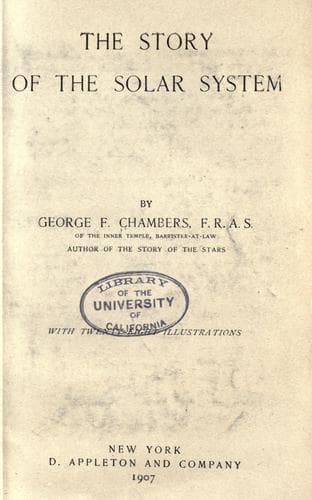
The Story of the Solar SystemChambers, George F. (George Frederick)
Science
The Story of the Solar System
Chambers, George F. (George Frederick)
Solar system
Venus has no satellite; this fact seems certain. Yet half a dozen or
more observers between 1645 and 1768 discovered such a satellite;
observed it; followed it! This startling mystery, as it really was,
attracted some years ago the attention of a very careful Belgian
observer, Stroobant, who examined in a most painstaking manner all the
recorded observations. His conclusions were that in almost all cases
particular stars (which he identified) were mistaken for a satellite.
Where the object seen was not capable of identification, possibly it was
a minor planet; whilst in one instance it was probable that it was
Uranus which had been seen and regarded as a satellite of Venus.
Venus is perhaps the planet which has most impressed the popular mind.
For the earliest illustration of this statement we must go as far back
as Homer who makes two references to it in the _Iliad_. These, in Pope’s
version, run as follows:—
“As radiant Hesper shines with keener light,
Far beaming o’er the silver host of night.”
—xxii. 399 [318].
“The morning planet told th’ approach of light;
And fast behind, Aurora’s warmer ray
O’er the broad ocean pour’d the golden day.”
—xxiii. 281 [226].
The phases of Venus were first discovered by Galileo and were made known
to the world, or rather to Kepler, in a mystic sentence which has often
been quoted:—
“_Hæc immatura, a me jam frustra leguntur—oy._”
“These things not ripe; at present [read] in vain [by others] are read
by me.”
The former sentence transposed becomes—
_Cynthiæ figuras æmulatur mater amorum._
The mother of loves [Venus] imitates the phases of Cynthia [the Moon].
Venus revolves round the Sun in 224½ days at a mean distance of about 67
millions of miles. Its apparent diameter varies between 9½″ in superior
conjunction, and 62″ in inferior conjunction. The real diameter is about
7500 miles; in other words Venus is nearly as large as the Earth.
CHAPTER V.
THE EARTH.
Public-domain text, read in full here on John Shaqi.
Reviews
Reviews
No reviews yet
Be the first to share your thoughts on this work.
Join the Discussion
Join the discussion
Sign in to leave a comment or review.
Sign InorCreate an account