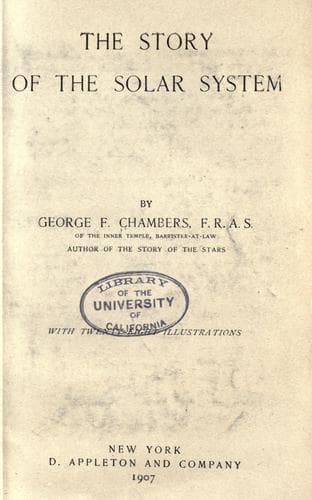
The Story of the Solar SystemChambers, George F. (George Frederick)
Science
The Story of the Solar System
Chambers, George F. (George Frederick)
Solar system
To us, as its inhabitants, the Earth appeals in two characters, and in
writing a book on astronomy it is necessary, yet difficult, to keep
these two characters separate. The Earth is an ordinary planet member of
the solar system, amenable to the same laws, impelled by the same
forces, and going through the same movements as the other members of the
Sun’s _entourage_. Yet, by reason of the fact that we are ourselves on
the Earth and are not spectators of it looking at it from at a distance,
there are many phenomena coming under our notice which require special
treatment, and it is often very difficult to say where the province of
the astronomer ends and that of the geographer begins. This volume being
specially designed to deal with astronomical matters, I shall pass over
many subjects which may be said to be on the border line, and which some
of my readers may therefore be disappointed not to find discussed.
Besides the geographer, the geologist and his scientific brother the
mineralogist are concerned with the Earth regarded as a planet moving
through space as the other planets do. The geologist studies the actual
structure of the Earth, its circumstances and history so far as they
have been revealed to us, whilst the mineralogist investigates and names
the materials of which it is composed, and classifies such materials
with the assistance of the geologist on the one hand and of the chemist
on the other. All these subordinate sciences—subordinate I mean from an
astronomer’s point of view—open up very varied, instructive, and
interesting fields of study, but they are of course foreign to the
purpose of the present volume.
Though the Earth is commonly regarded as a sphere it is not that in
reality, because it is not of identical dimensions from east to west and
from north to south. It is somewhat flattened at the poles; its polar
diameter is less than its equatorial diameter, in the ratio of about 298
to 299, or, expressed in miles, its polar diameter is about 26 miles
less than its equatorial diameter. If a globe 3 feet in diameter be
taken to represent the Earth, then the polar diameter will, on this
scale, be ⅛ inch too long. This flattening of the poles of the Earth
finds its counterpart, so far as we know, in most, and probably in all
of the planets. It is most considerable and therefore most conspicuous
in the case of Jupiter. It ought here to be added that a suspicion
exists that the equatorial section of the Earth is not a perfect circle,
but that the diameter of the Earth, taken through the points on the
equator marked by the meridians 13° 58′ and 193° 58′ east of Greenwich,
is one mile longer than the diameter at right angles to these two
points.
Public-domain text, read in full here on John Shaqi.
Reviews
Reviews
No reviews yet
Be the first to share your thoughts on this work.
Join the Discussion
Join the discussion
Sign in to leave a comment or review.
Sign InorCreate an account