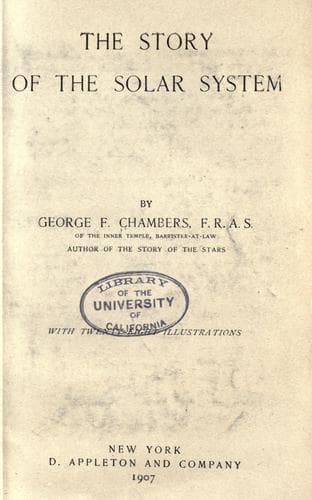
The Story of the Solar SystemChambers, George F. (George Frederick)
Science
The Story of the Solar System
Chambers, George F. (George Frederick)
Solar system
We have seen in a previous chapter that whilst the orbits of the planets
are nearly true circles, none of them are quite such: and the departure
from the truly circular form results in some important consequences.
Whilst some of these are too technical to be explained in detail here,
one at least must be referred to because of what it involves. Not only
is the Earth’s orbit eccentric in form, but its eccentricity varies
within narrow limits; and besides this the orbit itself, as a whole, is
subject to a periodical shift of place, from the joint effect of all
which changes it comes about that our seasons are now of unequal length,
the spring and summer quarters of the year unitedly extending to 186
days, whilst the autumn and winter quarters comprise only 178 days. The
sun therefore has the chance of shining for a longer absolute period of
time over the northern hemisphere than over the southern hemisphere;
hence the northern is the warmer of the two hemispheres, because it has
a better, because a longer, chance of storing up an accumulation of
solar radiant heat. Probably it is one result of this that the north
polar regions of the Earth are easier of access than the south polar
regions. In the northern hemisphere navigators have reached to 81° of
latitude, whereas 71° is the highest limit yet attained in the southern
hemisphere. Readers who have studied the history of explorations in the
Arctic regions will not need to be reminded of the controversy which has
so often arisen respecting the existence or nonexistence of an “Open
Polar Sea.”
It has already been hinted that it is not an easy matter to determine,
when dealing with the Earth, where astronomy and its allied sciences,
geography, geodesy and geology respectively, begin and end. But as
certain topics connected with these sciences, such as the rotundity of
the Earth and its rotation on its axis, will come more conveniently
under consideration in other volumes of this series, I shall pass them
over and only treat of a few things which more directly concern the
student of nature observing either with or without the assistance of a
telescope.
Public-domain text, read in full here on John Shaqi.
Reviews
Reviews
No reviews yet
Be the first to share your thoughts on this work.
Join the Discussion
Join the discussion
Sign in to leave a comment or review.
Sign InorCreate an account