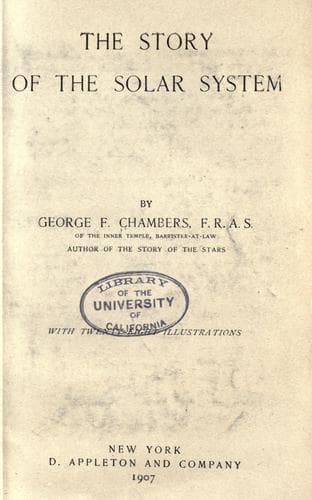
The Story of the Solar SystemChambers, George F. (George Frederick)
Science
The Story of the Solar System
Chambers, George F. (George Frederick)
Solar system
The fact that the Earth is surrounded by a considerable atmosphere
largely composed of aqueous vapour has a material bearing on the success
or failure of observations made on the Earth of bodies situated at a
distance. It may be taken as a general rule that the nearer an observer
is to the surface of the sea, or otherwise to the surface of the land at
the sea-level, the greater will be the difficulty which will confront
him in carrying on astronomical observations. Hence such observations
are generally made with unsatisfactory results on the sea coast or on
the banks of rivers. An interesting but rather ancient illustration of
this last-named fact is to be found in the circumstance that Copernicus,
who died at the age of 70, complained in his last moments that much as
he had tried he had never succeeded in detecting the planet Mercury, a
failure due, as Gassendi supposed, to the vapours prevailing near the
horizon at the town of Thorn on the banks of the Vistula where the
illustrious philosopher lived.
The phenomena depending on the presence of aqueous vapour in the
atmosphere which especially under the notice of the astronomer are
Refraction, Twilight, and the Twinkling of the Stars.
Refraction is what it professes to be, a bending, and what is bent is
the ray of light coming from a celestial object to a terrestrial
station. Olmsted has put the matter in this way:—“We must consider that
any such object always appears in the direction in which the _last_ ray
of light comes to the eye. If the light which comes from a star were
bent into fifty directions before it reached the eye, the star would
nevertheless appear in a line described by the ray nearest the eye. The
operation of this principle is seen when an oar, or any stick, is thrust
into the water. As the rays of light by which the oar is seen have their
direction changed as they pass out of water into air, the apparent
direction in which the body is seen is changed in the same degree,
giving it a bent appearance—the part below the water having apparently a
different direction from the part above.” The direction of this
refraction is determined by the general law of optics that when a ray of
light passes out of a rarer into a denser medium (for instance out of
air into water, or out of space into the Earth’s atmosphere) it is bent
_towards_ a perpendicular to the surface of the medium; but when it
passes out of a denser into a rarer medium it is bent _from_ the
perpendicular. The effect of refraction is to make a heavenly body
appear to have an apparent altitude greater than its true altitude, so
that, for example, an object situated actually _in_ the horizon will
appear _above_ it. Indeed it sometimes happens that objects which are
actually below the horizon and which otherwise would be invisible were
it not for refraction are thus brought into sight. It was in consequence
of this that on April 20, 1837, the Moon rose eclipsed before the Sun
had set.
Public-domain text, read in full here on John Shaqi.
Reviews
Reviews
No reviews yet
Be the first to share your thoughts on this work.
Join the Discussion
Join the discussion
Sign in to leave a comment or review.
Sign InorCreate an account