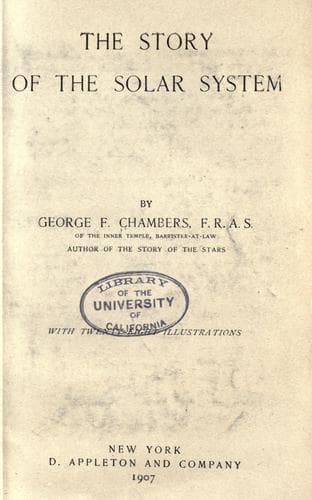
The Story of the Solar SystemChambers, George F. (George Frederick)
Science
The Story of the Solar System
Chambers, George F. (George Frederick)
Solar system
Though the foregoing information merely embraces a few general
principles and facts, the reader will have no difficulty in
understanding that refraction exercises a very inconvenient disturbing
influence on observations which relate to the exact places of celestial
objects. No such observations are available for mutual comparison,
however great the skill of the observer, or the perfection of his
instrument, unless, and until certain corrections are applied to the
observed positions in order to neutralise the disturbing effects of
refraction. In practice this is usually done by means of tables of
corrections, those in most general use being Bessel’s. Inasmuch as
refraction depends upon the aqueous vapour in the atmosphere, its amount
at any given moment is affected by the height of the barometer and the
temperature of the air. Accordingly when, for any purpose, the utmost
precision is required, it is necessary to take into account the height
of the barometer and the position of the mercury in the thermometer at
the moment in question. At the zenith there is no refraction whatever,
objects appearing projected on the background of the sky exactly in the
position they would occupy were the earth altogether destitute of an
atmosphere at all. The amount of the refraction increases gradually, but
in accordance with a very complex law, from the zenith to the horizon.
Thus the displacement due to refraction which at the zenith is nothing
and at an altitude of 45° is only 57″ becomes at the horizon more than
½°. One very curious consequence is involved in the fact that the
displacement due to refraction is at the horizon what it is; the
diameter both of the Sun and Moon may be said to be ½°, more or less, so
that when we see the lower edge of either of these luminaries just
_touching_ the horizon _in reality_ the whole disc is completely _below_
it, and would be altogether hidden by the convexity of the earth were it
not for the existence of the earth’s atmosphere and the consequent
refraction of the rays of light passing through it from the Sun (or
Moon) to the observer.
Public-domain text, read in full here on John Shaqi.
Reviews
Reviews
No reviews yet
Be the first to share your thoughts on this work.
Join the Discussion
Join the discussion
Sign in to leave a comment or review.
Sign InorCreate an account