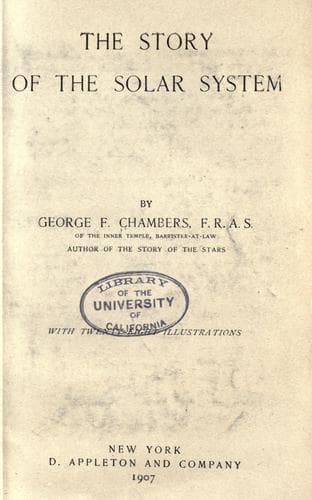
The Story of the Solar SystemChambers, George F. (George Frederick)
Science
The Story of the Solar System
Chambers, George F. (George Frederick)
Solar system
Twilight is another phenomenon associated with astronomical principles
and effects which depends in some degree on the Earth’s atmosphere and
on the laws which regulate the reflection and refraction of light. After
the Sun has set it continues to illuminate the clouds and upper strata
of the air just as it may often be seen shining on the tops of hills
long after it has disappeared from the view of the inhabitants of the
plains below, and indeed may illuminate the chimneys of a house when it
is no longer visible to a person standing in the garden below. The air
and clouds thus illuminated reflect some of the Sun’s light to the
surface of the earth lying immediately underneath, and thus produce
after sun-set and before sun-rise, in a degree more or less considerable
according as the Sun is only a little or is much depressed below the
horizon, that luminous glow which we call “twilight.” This word is of
Saxon origin and implies the presence of a twin, or double, light. As
soon as the Sun has disappeared below the horizon all the clouds
overhead continue for a few minutes so highly illuminated as to reflect
scarcely less light than the direct light of the Sun. As, however, the
Sun gradually sinks lower and lower, less and less of the visible
atmosphere receives any portion of its light, and consequently less and
less is reflected minute by minute to the Earth at the observer’s
station until at length the time comes when there is no sunlight to be
reflected—and it is night. The converse of all this happens before and
up to sun-rise; night ceases, twilight ensues, gradually becoming more
definite; the dawn appears, and finally the full Sun bursts forth. It
may here be stated as a note by the way that the circumstances under
which the Sun first shows itself after it has risen above the horizon
has some bearing on the probable character of the weather which is at
hand. When the first indications of day-light are seen above a bank of
clouds it is thought to be a sign of wind; but if the first streaks of
light are discovered low down, that is in, or very near the horizon,
fair weather may be expected.
Public-domain text, read in full here on John Shaqi.
Reviews
Reviews
No reviews yet
Be the first to share your thoughts on this work.
Join the Discussion
Join the discussion
Sign in to leave a comment or review.
Sign InorCreate an account