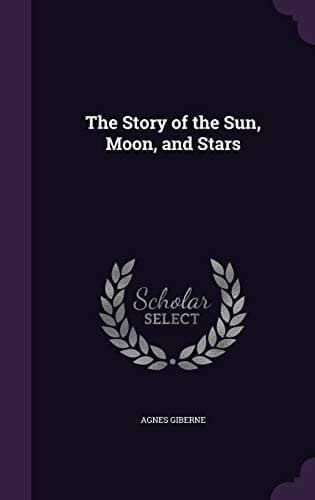
The story of the sun, moon, and starsGiberne, Agnes
Science
The story of the sun, moon, and stars
Giberne, Agnes
Astronomy -- Juvenile literature
The nearest star of all, whose distance has been measured, is Alpha
Centauri. It has been roughly calculated that a comet, passing direct
from Alpha Centauri to our sun, would take about twenty millions of
years for his journey. But here we tread upon very doubtful ground.
Many matters, at present unknown to us, might greatly affect the result
of such a calculation. Also it is by no means impossible that other
stars lie really much nearer to us than Alpha Centauri, whose distance
astronomers have not yet attempted to measure.
[Illustration: BARON ALEXANDER VON HUMBOLDT.]
“In order to complete our view,” says Alexander Von Humboldt, “of all
that we have learned to consider as appertaining to our Solar System,
which now, since the discovery of the small planets, of the interior
comets of short revolutions, and of the meteoric asteroids, is so rich
and complicated in its form, it remains for us to speak of the ring
of zodiacal light. Those who have lived for many years in the zone of
palms must retain a pleasing impression of the mild radiance with which
the zodiacal light, shooting pyramidally upward, illumines a part of
the uniform length of tropical nights. I have seen it shine with an
intensity of light equal to the Milky Way in Saggitarius, and that not
only in the rare and dry atmosphere of the summit of the Andes, at an
elevation of from thirteen to fifteen thousand feet, but even on the
boundless grassy plains of Venezuela, and on the seashore, beneath the
ever-clear sky of Cumana. This phenomenon was often rendered especially
beautiful by the passage of light, fleecy clouds, which stood out in
picturesque and bold relief from the luminous background.
“This phenomenon, whose primordial antiquity can scarcely be doubted,
is not the luminous solar atmosphere itself, which can not be diffused
beyond nine-tenths of the distance of Mercury. With much probability we
may regard the existence of a very compressed ring of nebulous matter,
revolving freely in space around the sun between the orbits of Venus
and Mars, as the material cause of the zodiacal light. These nebulous
particles may either be self-luminous or receive their light from the
sun.
Public-domain text, read in full here on John Shaqi.
Reviews
Reviews
No reviews yet
Be the first to share your thoughts on this work.
Elsewhere in the archive
Join the Discussion
Join the discussion
Sign in to leave a comment or review.
Sign InorCreate an account