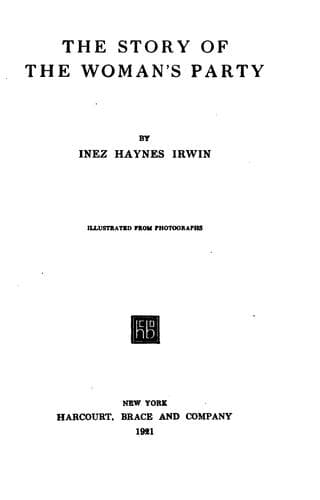
The Story of the Woman's PartyGillmore, Inez Haynes
History
The Story of the Woman's Party
Gillmore, Inez Haynes
National Woman's Party; Paul, Alice, 1885-1977; Women -- Suffrage -- United States
The dormitory was clean and cool and we longed to go to bed, but we
were told we must dress and go into the adjoining room where
Superintendent Whittaker would see us. Mr. Whittaker brought with
him a man whom we afterward learned was a newspaper man. The
superintendent informed us that for about an hour we could do as we
chose, and pointing to the piano said that we might play and sing.
The piano was not unlocked while we were there, but that night no
one had a desire to sing. Although Mr. Whittaker’s words were few
and not unpleasant, we realized that our presence did not cause him
either embarrassment or regret.
We were told that one dormitory was given up to colored women; in
the other one, the one in which we were to sleep, there would be
both colored and white women. We had asked to be allowed to have our
toilet things and were told we could not have them until the next
morning, that is, we would be permitted to have our combs and
toothbrushes then. But we were not permitted to have these until
Thursday. One woman told us we must not lend our comb to other
prisoners and must not mingle with the colored women....
The days were spent in the sewing-room. We were permitted to talk in
low tones, two or three being allowed to sit together. While we were
there, the sewing was very light. We turned hems on sheets and
pillow slips and sewed on the machine. There were both white and
colored women working in the sewing-room. The work was monotonous
and our clothing extremely heavy.
The great nervous strain came at meal time. All the women ate in one
big room. The white women sat at one side. The meal lasted thirty
and sometimes forty minutes. The food to us was not palatable, but
we all tried to be sensible and eat enough to keep up our strength.
The real problem, however, was not the food; it was the enforced
silence. We were not allowed to speak in the dining-room, and after
a conscientious effort to eat, the silent waiting was curiously
unpleasant....
The use of the pencil is forbidden at all times. Each inmate is
permitted to write but two letters a month, one to her family and
one business letter. All mail received and sent is opened and read
by one of the officials. Next to our longing for our own toilet
articles was our desire for a pencil and a scrap of paper. Another
rule which makes life in the Workhouse more difficult than life in
the jail is that the Workhouse prisoners are not permitted to
receive any food sent in from outside.
We found that the other prisoners were all amazed at the excessive
sentences we had received. Old offenders, they told us, received
only thirty days.
In the _Suffragist_ of August 11, Doris Stevens, who was a member of the
same group says:
Public-domain text, read in full here on John Shaqi.
Reviews
Reviews
No reviews yet
Be the first to share your thoughts on this work.
Elsewhere in the archive
Join the Discussion
Join the discussion
Sign in to leave a comment or review.
Sign InorCreate an account