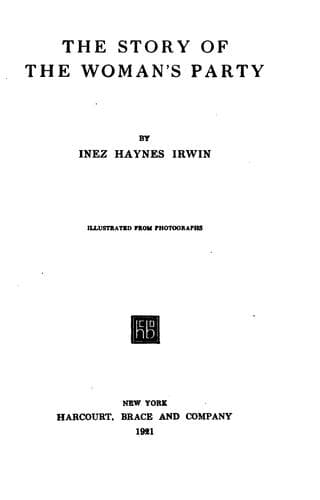
The Story of the Woman's PartyGillmore, Inez Haynes
History
The Story of the Woman's Party
Gillmore, Inez Haynes
National Woman's Party; Paul, Alice, 1885-1977; Women -- Suffrage -- United States
In the towns where it was impossible to get a hall, Miss Younger did not
stay to fight it out. First of all, she felt the situation had developed
into a free speech fight between the people of these towns and their
local governments. It was for them to make the fight. Moreover, she
wanted as far as possible to keep to her schedule.
Sue White went on ahead to Jackson, which was her own home town, and
appealed to the Judge for the use of the Court House. The Mayor said he
could not legally prevent the meeting. Miss White opened the Court House
and lighted it. In the meantime, the Chief of Police met Miss Younger in
the Court House before the meeting began. He told her if she said
anything against the President, he would arrest her. He came to the
meeting that night, but left as soon as he discovered how harmless it
was—harmless, that is, so far as the President was concerned. The
audience unanimously passed a resolution asking the Mayor of Nashville,
which was the next stop, to permit Miss Younger to speak.
However, when she got to Nashville, the Home Defense League had brought
pressure on the local authorities and it was impossible for her to get a
hall. The organizer had hired the ball-room of the hotel, had deposited
twenty-five dollars for it; but the manager broke his contract, refused
to allow them to use it, and refunded the money. The prosecuting
attorney, months later, boasted, “I was the one that kept Miss Younger
from speaking in Nashville.”
The next two towns were Lebanon and Gallatin. In Lebanon, although they
could get no hall, they were allowed to speak in the public square. Sue
White introduced Miss Younger. It was a bitter cold day; but the weather
was not colder than the audience at first. Gradually, however, that
audience warmed up. When Miss Younger finished, they called, “We are all
with you!” When the Suffragists reached Gallatin, they secured the
schoolhouse. There was no time for any publicity, but Rebecca Hourwich
hired a wagon and went about the town calling, “Come to the schoolhouse!
Hear the White House pickets!”
Public-domain text, read in full here on John Shaqi.
Reviews
Reviews
No reviews yet
Be the first to share your thoughts on this work.
Elsewhere in the archive
Join the Discussion
Join the discussion
Sign in to leave a comment or review.
Sign InorCreate an account