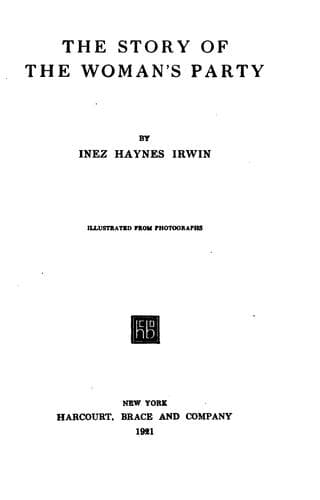
The Story of the Woman's PartyGillmore, Inez Haynes
History
The Story of the Woman's Party
Gillmore, Inez Haynes
National Woman's Party; Paul, Alice, 1885-1977; Women -- Suffrage -- United States
IV
THE PRESIDENT CAPITULATES AND THE HOUSE SURRENDERS
IT will be remembered that after the eight months in which the Woman’s
Party picketed the President, the House of Representatives created a
Suffrage Committee in September, 1917. It will also be remembered that
during the discussion on the floor, in regard to that Committee, Mr.
Pou, Chairman, made the statement that there was no intention of passing
the Amendment before the Sixty-sixth Congress. That Congress adjourned
on October 6, 1917. Also, it will be remembered that that day, Alice
Paul marched over to the White House gates carrying a banner inscribed
with the words of the President:
THE TIME HAS COME WHEN WE MUST CONQUER OR SUBMIT.
FOR US THERE CAN BE BUT ONE CHOICE. WE HAVE MADE IT.
It will be remembered too that Alice Paul was arrested and sentenced to
seven months in jail.
Following the publicity which came from the Woman’s Party speakers all
over the country and from the newspapers, protests of all descriptions
began to pour into the White House and to the Democratic leaders:
letters, resolutions, petitions.
Again it will be remembered that a week before Congress reconvened on
December 3, 1917, all the imprisoned women were suddenly released.
In the new Session—a direct reversal of Mr. Pou’s announcement of two
months earlier that the House would not pass the Amendment before 1920—a
day was set for the vote on the Suffrage Amendment, a week after
Congress assembled.
Again, it should be pointed out that all these things happened after
those eight months of picketing.
That important day which the House set was January 10, 1918. In
September, the Suffragists lacked seventy-three votes of the passage of
the Amendment. Naturally all December was spent in working up that vote.
The National Woman’s Party secured statements from Republican leaders
like Mondell and Kahn, stating the strong Republican support of the
measure and blaming the Democrats if it were defeated. The National
Woman’s Party worked up the Republican majority from three-quarters of
the House to five-sixths. The Democrats began to be frightened at the
press statements of the Republicans. They began to work to increase
their showing, as they feared the country would blame them if the
Amendment were defeated.
But more important than any of these things was the capitulation of the
President which won, as the Woman’s Party contended it would, the
necessary votes in the house. On January 9, 1919, one year from the day
the Inez Milholland Memorial Deputation visited him, President Wilson
made his declaration for the Federal Amendment, and on January 10, the
Amendment was passed in the House by a vote of two hundred and
seventy-four to one hundred and thirty-six.
This important epoch in the history of the Suffrage Movement, Maud
Younger describes in her _Revelations of a Woman Lobbyist_.
Public-domain text, read in full here on John Shaqi.
Reviews
Reviews
No reviews yet
Be the first to share your thoughts on this work.
Elsewhere in the archive
Join the Discussion
Join the discussion
Sign in to leave a comment or review.
Sign InorCreate an account