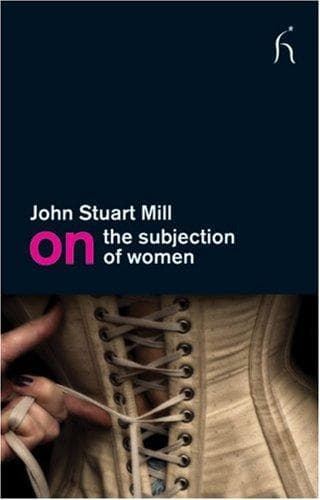
Women -- Social and moral questions; Women's rights
capacity should prefer doing almost anything else, not in their own
eyes degrading, rather than marry, when marrying is giving themselves
a master, and a master too of all their earthly possessions. And
truly, if this consequence were necessarily incident to marriage, I
think that the apprehension would be very well founded. I agree in
thinking it probable that few women, capable of anything else, would,
unless under an irresistible _entrainement_, rendering them for the
time insensible to anything but itself, choose such a lot, when any
other means were open to them of filling a conventionally honourable
place in life: and if men are determined that the law of marriage
shall be a law of despotism, they are quite right, in point of mere
policy, in leaving to women only Hobson's choice. But, in that case,
all that has been done in the modern world to relax the chain on the
minds of women, has been a mistake. They never should have been
allowed to receive a literary education. Women who read, much more
women who write, are, in the existing constitution of things, a
contradiction and a disturbing element: and it was wrong to bring
women up with any acquirements but those of an odalisque, or of a
domestic servant.
[Footnote 1: Title-page of Mme. de Stael's “Delphine.”]
CHAPTER II.
It will be well to commence the detailed discussion of the subject by
the particular branch of it to which the course of our observations
has led us: the conditions which the laws of this and all other
countries annex to the marriage contract. Marriage being the
destination appointed by society for women, the prospect they are
brought up to, and the object which it is intended should be sought
by all of them, except those who are too little attractive to be
chosen by any man as his companion; one might have supposed that
everything would have been done to make this condition as eligible to
them as possible, that they might have no cause to regret being
denied the option of any other. Society, however, both in this, and,
at first, in all other cases, has preferred to attain its object by
foul rather than fair means: but this is the only case in which it
has substantially persisted in them even to the present day.
Originally women were taken by force, or regularly sold by their
father to the husband. Until a late period in European history, the
father had the power to dispose of his daughter in marriage at his
own will and pleasure, without any regard to hers. The Church,
indeed, was so far faithful to a better morality as to require a
formal “yes” from the woman at the marriage ceremony; but there was
nothing to shew that the consent was other than compulsory; and it
was practically impossible for the girl to refuse compliance if the
father persevered, except perhaps when she might obtain the
protection of religion by a determined resolution to take monastic
vows. After marriage, the man had anciently (but this was anterior to
Public-domain text, read in full here on John Shaqi.
Reviews
Reviews
No reviews yet
Be the first to share your thoughts on this work.
Join the Discussion
Join the discussion
Sign in to leave a comment or review.
Sign InorCreate an account