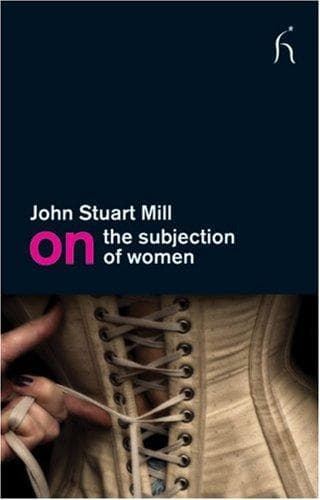
Women -- Social and moral questions; Women's rights
Christianity) the power of life and death over his wife. She could
invoke no law against him; he was her sole tribunal and law. For a
long time he could repudiate her, but she had no corresponding power
in regard to him. By the old laws of England, the husband was called
the _lord_ of the wife; he was literally regarded as her sovereign,
inasmuch that the murder of a man by his wife was called treason
(_petty_ as distinguished from _high_ treason), and was more cruelly
avenged than was usually the case with high treason, for the penalty
was burning to death. Because these various enormities have fallen
into disuse (for most of them were never formally abolished, or not
until they had long ceased to be practised) men suppose that all is
now as it should be in regard to the marriage contract; and we are
continually told that civilization and Christianity have restored to
the woman her just rights. Meanwhile the wife is the actual
bond-servant of her husband: no less so, as far as legal obligation
goes, than slaves commonly so called. She vows a lifelong obedience
to him at the altar, and is held to it all through her life by law.
Casuists may say that the obligation of obedience stops short of
participation in crime, but it certainly extends to everything else.
She can do no act whatever but by his permission, at least tacit. She
can acquire no property but for him; the instant it becomes hers,
even if by inheritance, it becomes _ipso facto_ his. In this respect
the wife's position under the common law of England is worse than
that of slaves in the laws of many countries: by the Roman law, for
example, a slave might have his peculium, which to a certain extent
the law guaranteed to him for his exclusive use. The higher classes
in this country have given an analogous advantage to their women,
through special contracts setting aside the law, by conditions of
pin-money, &c.: since parental feeling being stronger with fathers
than the class feeling of their own sex, a father generally prefers
his own daughter to a son-in-law who is a stranger to him. By means
of settlements, the rich usually contrive to withdraw the whole or
part of the inherited property of the wife from the absolute control
of the husband: but they do not succeed in keeping it under her own
control; the utmost they can do only prevents the husband from
squandering it, at the same time debarring the rightful owner from
its use. The property itself is out of the reach of both; and as to
the income derived from it, the form of settlement most favourable to
the wife (that called “to her separate use”) only precludes the
husband from receiving it instead of her: it must pass through her
hands, but if he takes it from her by personal violence as soon as
she receives it, he can neither be punished, nor compelled to
restitution. This is the amount of the protection which, under the
laws of this country, the most powerful nobleman can give to his own
daughter as respects her husband.
Public-domain text, read in full here on John Shaqi.
Reviews
Reviews
No reviews yet
Be the first to share your thoughts on this work.
Join the Discussion
Join the discussion
Sign in to leave a comment or review.
Sign InorCreate an account