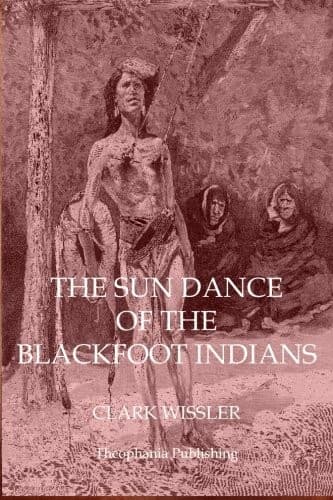
The Sun Dance of the Blackfoot IndiansWissler, Clark
Religion
The Sun Dance of the Blackfoot Indians
Wissler, Clark
Siksika Indians; Sun dance
sun are made. It should be noted that they are regarded as independent
of and in no way associated with the medicine woman ceremonies or the
erection of the dancing lodge, but upon entrance to the booth, the
leading weather dancer is said to become the chief and director of all
succeeding ceremonies. The length of the ceremony depends entirely upon
him and formerly continued as long as he kept his place.
Like other rites this one was bought and sold, but it was usual to
continue in ownership many years. Anyone could make a vow to dance with
the weather dancer and join him in his ceremonies, but such vows were
usually made by former owners of the rite. When one makes a vow to
purchase the rite, its owner must sell, however reluctant he may be. The
transfer must be in the sun dance. It is said that two men once
alternately sold to each other for many years so that both could appear
in every sun dance.
FOOTNOTES:
[12] Clark, W. P., _The Indian Sign Language_ (Philadelphia, 1885),
72.
DANCING.
The first ceremony of this character is named the cutting-out dance (to
cut out a hole in a robe). It seems to have been performed by a society
and occurs early on the fifth day. About four or six old men dance in
line with a rawhide which they hold in front of them, singing and
beating time on the rawhide with rattles similar to those of the beaver
men. The society now divides into two parties, one placing itself north
of the center pole, and the other party standing in line south of the
center pole. The two parties dance back and forward in front of the pole
shooting at it. The old men on the west side of the center pole dance
in their places. The rawhide held in front of them, hangs down like an
apron. They beat time on it, holding the rawhide in one hand, and the
rattles in the other. An old man counts deeds and marks out with a knife
the fireplace and the booth for the weather dancers. These are dug while
the dancing and shooting take place.[13]
The hole, or fire pit, is dug between the sun pole and the entrance to
the dancing lodge. It is about three feet by two and "two hands" deep. A
warrior is then called to start the fire. Warriors now come forward in
turn to count their coups. In this a man took a piece of firewood and
holding it up, called out in a loud voice how he once struck a Sioux, a
Snake, etc., then placed it in the fire. When he had recounted all he
gave way to the next. Stories are told of men having enough coups to
make a fire large enough to threaten the destruction of the dancing
lodge. We were able to confirm the statement of Clark[14] that the
height of the flame as determined by a buffalo tail hanging down was the
criterion for determining a great warrior. One informant states as
follows:--
Public-domain text, read in full here on John Shaqi.
Reviews
Reviews
No reviews yet
Be the first to share your thoughts on this work.
Join the Discussion
Join the discussion
Sign in to leave a comment or review.
Sign InorCreate an account