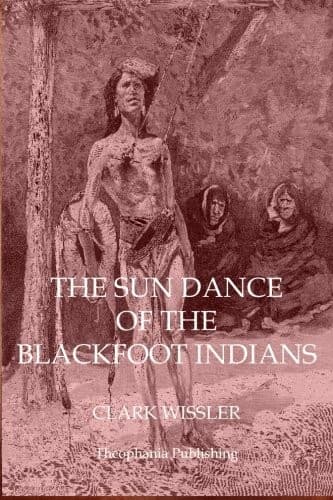
The Sun Dance of the Blackfoot Indians — John Shaqi
The Sun Dance of the Blackfoot IndiansWissler, Clark
Religion
The Sun Dance of the Blackfoot Indians
Wissler, Clark
Siksika Indians; Sun dance
There is always a cow tail hanging down from the center post. In olden
times this was a buffalo tail, to the end of which a blackened plume was
tied. This hangs down over the fireplace which was used at night to
furnish light for the proceedings. The assembled people were entertained
by narratives of warriors as they came forward to narrate their deeds;
each threw a stick on the fire for each deed counted and he whose fire
blazed high enough to reach the tail was considered a great warrior. It
was a great honor when a man could tell enough war deeds to scorch the
tail. All this time there was singing (the cheering songs) and drumming,
while berry soup was served to all. The persons taking part are
designated as those "who are about to make the fire." In recent years,
this ceremony has been performed in a very perfunctory manner.
After the ceremony, the fire was fed in the ordinary way and kept going
during the greater part of the succeeding days. The origin of this dance
is often ascribed to Scar-face.
FOOTNOTES:
[13] It will be recalled that in the sun dance of the Dakota type (p.
110) there is a ceremonial shooting at the sun pole. Here the shooting
takes place in a perfunctory way, while the pole is dragged to the sun
dance site. Yet, McQuesten claims to have witnessed the driving of
evil power from the sun lodge at a Blood ceremony in 1912. ("The Sun
Dance of the Blackfeet" _Rod and Gun in Canada_, March 1912.) As this
is not noted in older accounts and we failed to get information as to
it, we suspect it to be due to foreign influences, or perhaps the
author's own interpretation.
[14] Clark, _ibid._, 72.
SOCIETY DANCES.
In former times, the succeeding days were apportioned to the men's
societies (the ikunukats) in the order of their rank, beginning at the
lowest.[15] There seems to have been no fixed allotment of time to each,
only the order of succession being adhered to. The ceremonies were
determined chiefly by the respective society rituals, though the
recounting of deeds in war was given great prominence. As a rule, each
society closed its ceremonies by offering parts of its regalia, etc., to
the sun, a custom still observed by the Blood (See vol. 11, this series,
fig. 19, p. 411). After the highest society had completed its function,
the leading men of the tribe held a kind of a war dance in which coups
were recounted. In this dance, again, rattles were beaten upon a
rawhide. The organizations or persons having charge of the day's
ceremonies must furnish the feast and all necessaries. The medicine
woman and her husband usually repair to the dancing lodge each day. The
man usually takes his pipe and tobacco and furnishes the smoking for the
guests who sit around. His wife wears the buckskin dress and elk robe,
but not the natoas. They sit on the north or right side of the booth and
merely are spectators. This closes the ceremonies and camp is broken.
FOOTNOTES:
Public-domain text, read in full here on John Shaqi.
Reviews
Reviews
No reviews yet
Be the first to share your thoughts on this work.
Join the Discussion
Join the discussion
Sign in to leave a comment or review.
Sign InorCreate an account