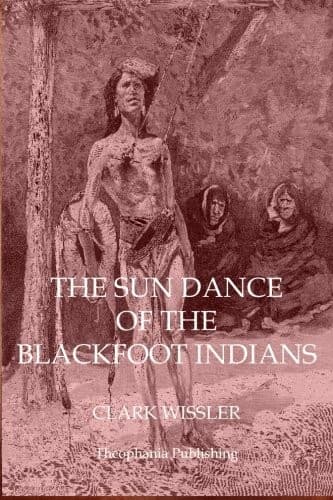
The Sun Dance of the Blackfoot Indians — John Shaqi
The Sun Dance of the Blackfoot IndiansWissler, Clark
Religion
The Sun Dance of the Blackfoot Indians
Wissler, Clark
Siksika Indians; Sun dance
According to our information, the four camps of the medicine woman was
the rule in olden times and a hundred-willow sweathouse was made at each
camp. In recent times, but two moves seem to have been made; the first
day marking the move from the regular home camp to the temporary one
where the second day is also spent. But one of the hundred-willow
sweathouses is now made--the one on the third day. Also, where formerly
they used the ordinary type of sweathouse, at the close of the fourth
day, the men now return to the hundred-willow sweathouse. The time then
was "when the service berries are ripe", perhaps August, instead of
Fourth-of-July week, as in recent years.[2] Even the fast is much
abbreviated, usually but of two days' duration.
FOOTNOTES:
[1] As in many other cases, there is a difference of opinion as to
what was, or is, the correct schedule. Some maintain that the timber
and sun pole are brought in on the fourth day and the fifth day given
over to the erection of the dancing lodge only. This is, however, a
matter of no great moment.
[2] See Grinnell, George Bird, _Blackfoot Lodge Tales_ (New York,
1903), 264, for program.
THE VOW.
The most important functionary in the Blackfoot sun dance is a woman,
known among the whites as the medicine woman, and upon a clear
comprehension of her functions and antecedents depends our understanding
of the ceremony itself. Accordingly, we shall proceed with as complete
an exposition of her office as the information at hand allows. In the
first place, a sun dance cannot occur unless some woman qualifies for
the office. On the other hand, it was almost inconceivable that there
should be a summer in which such a qualification would not be made. This
attitude of our informants implies that public opinion had sufficient
force to call out volunteers against their own wills. There was a
feeling that an annual sun dance was, from a religious and ethical point
of view, necessary to the general welfare, for which some individual
ought to sacrifice personal comfort and property to the extent required
by custom. As we shall see later, this was no small price to pay for a
doubtful honor. This feeling was sure to express itself in the subtle
ways peculiar to Indian society, if need be, to the direct suggestion of
a candidate who in turn felt impelled to come forward as if prompted
entirely from within.
Public-domain text, read in full here on John Shaqi.
Reviews
Reviews
No reviews yet
Be the first to share your thoughts on this work.
Join the Discussion
Join the discussion
Sign in to leave a comment or review.
Sign InorCreate an account