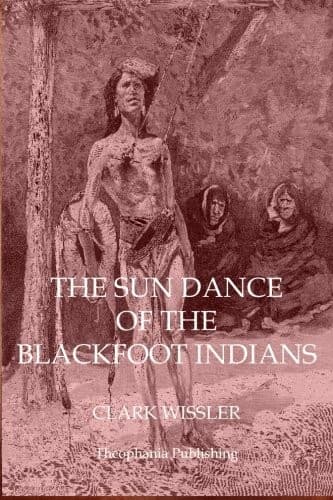
The Sun Dance of the Blackfoot IndiansWissler, Clark
Religion
The Sun Dance of the Blackfoot Indians
Wissler, Clark
Siksika Indians; Sun dance
As a rule, however, the woman qualifies by a vow. Oftimes, when a member
of the family is dangerously ill, one of the women goes out of the tipi
and raising her eyes to the sun calls upon it that health may be
restored to the ailing one. In such an appeal she offers to make gifts
to the sun, usually specifying that she will sacrifice a piece of cloth,
a dress, a robe, an ax, etc., which are after a time, provided the sick
one improves, hung in trees or deposited upon a hill. Such appeals are
still made with great frequency. It is believed that unless the woman
has been industrious, truthful, and above all, true to her marriage
vows, her appeal will not be answered. Sometimes, when the woman
addresses the sun she promises to be the medicine woman at the next sun
dance. She herself may be ill and promise such a sacrifice in case she
receives help. Again, she may, out of gratitude for the satisfactory way
in which her prayers have been answered, announce her intention to take
this step. In such a case, a formal announcement is made to the sun. In
company with a man, usually a medicineman experienced in the ceremonies,
she steps out into the camp, where they face the sun whom the man
addresses, explaining that as this woman asked for help in time of need
and that inasmuch as it was granted, she in turn promises to be the
medicine woman at the first opportunity. Some such formal announcement
is made in every case where the prayers have been answered. By this
formality, the vow receives public registry.
As indicated above, the prayers are not always granted. In such cases,
the promises are not only not binding, but to proceed with the sun
dance, or to take a secondary part in it, would be to the detriment of
all concerned. The fault is said to lie in the woman's life and that
only the wrath of the sun would be invoked by her participation in the
ceremonies.
It may be asked if a man can make such a vow. He may and does often call
upon the sun, promising gifts of property or even scalps and may
promise to furnish the material support for a wife, mother, sister, or
in fact any woman who will come forward to perform the ceremony. Thus, a
Blood chief once told us that he had been very ill all winter; that he
had tried all kinds of doctors without relief, until he was stripped of
all his property. At last, he recovered and then made a vow that with
the help of his wife he would give the sun dance. This he did, but, as
he expressed it, "with great difficulty because he was then poor and did
not receive adequate help from his relatives."
Public-domain text, read in full here on John Shaqi.
Reviews
Reviews
No reviews yet
Be the first to share your thoughts on this work.
Join the Discussion
Join the discussion
Sign in to leave a comment or review.
Sign InorCreate an account