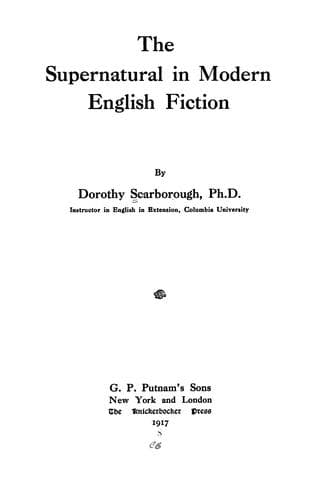
The Supernatural in Modern English Fiction — John Shaqi
The Supernatural in Modern English FictionScarborough, Dorothy
History
The Supernatural in Modern English Fiction
Scarborough, Dorothy
English fiction -- History and criticism; Supernatural in literature
Shall I even confess to you what was the origin of this romance? I
waked one morning from a dream, of which all that I could recall
was that I had thought myself in an ancient castle (a very natural
dream for a head filled like mine with Gothic story) and that at
the uppermost banister of a great staircase I saw a gigantic hand
in armor. In the evening I sat down and began to write, without
knowing in the least what I intended to say or relate. The work
grew on my hands.
Mary Shelley's _Frankenstein_ was likewise born of a dream. "Monk"
Lewis had interested Byron, Polidori, and the Shelleys in supernatural
tales so much so that after a fireside recital of German terror stories
Byron proposed that each member of the group should write a ghostly
romance to be compared with the compositions of the others. The results
were negligible save _Frankenstein_, and it is said that Byron was much
annoyed that a mere girl should excel him. At first Mrs. Shelley was
unable to hit upon a plot, but one evening after hearing a discussion
of Erasmus Darwin's attempts to create life by laboratory experiments,
she had an idea in a half waking dream. She says:
I saw--with shut eyes but acute mental vision--I saw the pale
student of unhallowed arts kneeling beside the thing he had put
together. I saw the hideous phantasm of a man stretched out,
and then, on the working of some powerful engine, show signs of
life.... The artist sleeps but he is awakened; and behold, the
horrid thing stands at his bedside, looking on him with watery,
yellow yet speculative eyes!
And from this she wrote her story of the man-monster.
The relation of dreams to the uncanny tale is interesting. Dreams
and visions, revelatory of the past and prophetic of the future,
played an important part in the drama (as they are now widely used in
motion-picture scenarios) and the Gothic novel continues the tradition.
It would be impossible to discover in how many instances the authors
were subconsciously influenced in their choice of material by dreams.
The presaging dreams and visions attributed to supernatural agency
appear frequently in Gothic fiction. The close relation between dreams
and second sight in the terror novel might form an interesting by-path
for investigation. Dream-supernaturalism becomes even more prominent in
later fiction and contributes passages of extraordinary power of which
De Quincey's _Dream-Fugue_ may be mentioned as an example.
The germinal idea for _Melmoth, the Wanderer_ was contained in a
paragraph from one of the author's own sermons, which suggested a theme
for the story of a doomed, fate-pursued soul.
Public-domain text, read in full here on John Shaqi.
Reviews
Reviews
No reviews yet
Be the first to share your thoughts on this work.
Join the Discussion
Join the discussion
Sign in to leave a comment or review.
Sign InorCreate an account