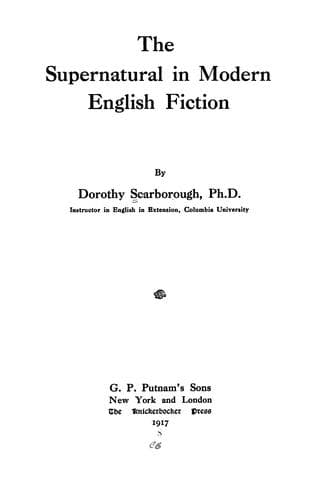
The Supernatural in Modern English FictionScarborough, Dorothy
History
The Supernatural in Modern English Fiction
Scarborough, Dorothy
English fiction -- History and criticism; Supernatural in literature
The pagan poetry of the Gaelic race lives on and throbs over again in
Fiona McLeod's symbolic moralities. The mystical figures of awe and
woe appear from the dim past, a rapturous paganism showing through the
medieval religious brooding. Yet they are so symbolic of the spirit
that they are timeless. Coming as they do out of the dim legendary
past, they may reflect the veiled years of the future. They are mystic
chronicles of the soul, as in _The Divine Adventure_, where the Body
and Will alike shrink back from that "silent, sad-eyed foreigner, the
Soul."
In the stories of Yeats we get similar effects, the weird power of the
old curse-making bards, the gift of second-sight, a spiritual vision,
the spiritual sense that hears past the broken discordant sounds the
music of the world, the power to catch the moment "that trembles with
the Song of Immortal Powers." We hear faint whispers, catch fleeting
glimpses of the Dim People, see again the druids, the culdees, the
ancient bards and heroes. We discern in the Celtic literature a
sadness, dim, unreasoning yet deep, such as we see in the faces of
animals and little children. We see such symbolism as that of the
self-centered lovers who have heart-shaped mirrors instead of hearts,
seeing only their own images throughout eternity. We feel the poetic
thoughts drifting past us like sweet falling rose-leaves, bright with
the colors of bygone years, like fluttering bird-wings, like happy
sighs. Yet again they are terrible trumpets blown in the day of doom.
We have the modern mysticism and symbolism side by side with the old
druidic mysticism, which seems like dream-stuff with deep spiritual
import. Yeats makes us feel that the old divinities are not dead,
but have taken up their abode in the hearts of poets and writers of
romance, and that the land of faery is all about us if we would only
see. But we lack the poetic vision. He makes us see the actuality of
thought, that thinking has its own vital being and goes out into the
world like a living thing, possessed by some wandering soul. He shows
us that thought can create black hounds or silver doves to follow the
soul, bring to life at will a divinity or a demon.
Public-domain text, read in full here on John Shaqi.
Reviews
Reviews
No reviews yet
Be the first to share your thoughts on this work.
Elsewhere in the archive
Join the Discussion
Join the discussion
Sign in to leave a comment or review.
Sign InorCreate an account