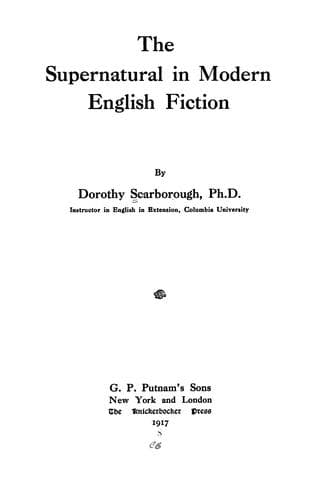
The Supernatural in Modern English Fiction — John Shaqi
The Supernatural in Modern English FictionScarborough, Dorothy
History
The Supernatural in Modern English Fiction
Scarborough, Dorothy
English fiction -- History and criticism; Supernatural in literature
The devil doesn't keep to his agreement to release him, however, for
Lewis tells us that taking his victim to the top of a mountain and
"darting his talons into the monk's shaven crown, he sprang with him
from the rock. The caves and mountains rang with Ambrosio's shrieks.
The demon continued to soar aloft till, reaching a dreadful height,
he released the sufferer. Headlong fell the monk." He plunges to the
river's brink, after which a storm is evoked by the devil and his body
swept away in the flood.
A similar dæmonic manifestation occurs in _Zofloya_. Victoria has been
induced to bind herself to the Evil One, who has appeared as a Moorish
servant of impressive personality and special powers. He grants her
wishes hostile to her enemies, holding many conferences with her in
the dark forest where he is heralded by flute-like sounds. He appears
sometimes like a flame, sometimes like a lightning flash. He comes with
the swiftness of the wind and tells her that her thoughts summoned
him. At last, he announces himself as Satan, and assumes his own
hideous form of gigantism.
Behold me as I am, no longer that which I appeared to be, but the
sworn enemy of all created nature, by men called Satan. Yes, it was
I that under semblance of the Moor appeared to thee.
As he spoke, he grasped more firmly the neck of Victoria, with one
push he whirled her headlong down the dreadful abyss!--as she fell
his loud dæmonic laugh, his yells of triumph echoed in her ears;
and a mangled corpse she fell, she was received into the foaming
waters below.
The devil is seen in _Vathek_ as a preternaturally ugly old man with
strange powers. James Hogg has rather a penchant for the demon, for he
uses him in The _Wool-Gatherer_, and in _Confessions of a Justified
Sinner_, which is a story of religious superstition, of the use of
diablerie and witchcraft, introducing a satanic tempter. On the whole,
the appearances of the devil in Gothic fiction lack impressiveness, are
weak in psychologic subtlety, and have not the force either of the epic
or of the dramatic representations. Nor have they the human appeal that
the incarnations of the devil in later fiction make to our sympathies.
Public-domain text, read in full here on John Shaqi.
Reviews
Reviews
No reviews yet
Be the first to share your thoughts on this work.
Join the Discussion
Join the discussion
Sign in to leave a comment or review.
Sign InorCreate an account