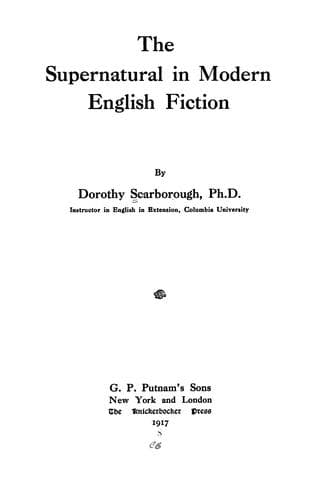
The Supernatural in Modern English Fiction — John Shaqi
The Supernatural in Modern English FictionScarborough, Dorothy
History
The Supernatural in Modern English Fiction
Scarborough, Dorothy
English fiction -- History and criticism; Supernatural in literature
In addition to the unholy powers possessed by the devil and given by
him to his agents, the witches, warlocks and magicians, we see in
Gothic fiction other aspects of dæmonology, such as that associated
with animals and with inanimate objects. Supernaturalism in the horror
novel is by no means confined to human beings, but extends to beasts
as well. Animals are supposed to be peculiarly sensitive to ghostly
impressions, more so than men, and the appearance of a specter is
often first announced by the extreme terror of some household pet,
or other animal. Gothic dogs have very keen noses for ghosts and howl
lugubriously when an apparition approaches. Ravens are represented as
showing the presence of evil powers, somewhat as the Southern darkey
believes that the jay-bird is the ally of the devil and spends every
Friday in torment. And one does not forget the snaky coiffure that
writhed around the demon's head in _The Monk_.
Maturin's _Albigenses_ introduces the story of a gruesome loup-garou,
or werewolf, which figures extensively in folk-tales. In this case
the husband of a beautiful young woman is a werewolf who during his
savage metamorphosis tears her to pieces then disappears to return no
more. This is suggestive--with a less satisfactory ending--of Marie de
France's charming little _lai_, _Le Bisclavret_. Professor Kittridge
has shown the frequency of the werewolf motif in medieval story, by
the variants he brings together in his _Arthur and Gorlogon_. In _The
Albigenses_ a lycanthrope also is described, a hideous human being that
fancies himself a mad wolf.
There is much use of animal supernaturalism in James Hogg's romances.
In one,[18] Sandy is saved from going over a precipice by the warning
of a hare that immediately after vanishes, having left no tracks in
the snow. In another,[19] the two white beagles that the king uses in
hunting are in reality maidens bound by enchantment, who are forced
to slay human beings then transform them into deer for the king and
his company to eat. The other dogs are aware of the unnatural state
of affairs, while the men are too stupid to realize it. The clownish
Croudy is changed into a hog, which brings amusing and almost tragic
complications into his life. His old dog knows him and follows him
pathetically, and a drove of cows go off in a stampede at his approach,
for they, too, sense the supernatural spell. Croudy is put on the
block to be killed for pork, when the fairy changes him back suddenly
to the consternation of the butcher. But Croudy does not behave well
after his transformation, so he is changed into a cat with endless
life. He may resume mortal shape one night in the year and relate his
feline experiences.
[18] _The Wool-Gatherer._
[19] _The Hunt of Eildon._
Public-domain text, read in full here on John Shaqi.
Reviews
Reviews
No reviews yet
Be the first to share your thoughts on this work.
Join the Discussion
Join the discussion
Sign in to leave a comment or review.
Sign InorCreate an account