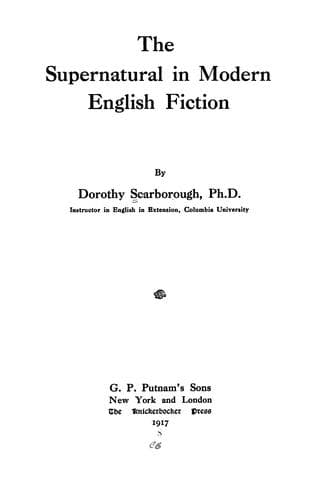
The Supernatural in Modern English FictionScarborough, Dorothy
History
The Supernatural in Modern English Fiction
Scarborough, Dorothy
English fiction -- History and criticism; Supernatural in literature
The Gothic period marked a change in the vehicle of supernaturalism. In
ancient times the ghostly had been expressed in the epic or the drama,
in medievalism in the romances, metrical and prose, as in Elizabethan
literature the drama was the specific form. But Gothicism brought it
over frankly into the novel, which was a new thing. That is noteworthy,
since supernaturalism seems more closely related to poetry than to
prose; and as the early dramas were for the most part poetic, it did
not require such a stretch of the imagination to give credence to
the unearthly. The ballad, the epic, the drama, had made the ghostly
seem credible. But prose fiction is so much more materialistic that
at first thought supernaturalism seems antagonistic to it. That this
is not really the case is evidenced from the fact that fiction since
the terror times has retained the elements of awe then introduced, has
developed, and has greatly added to them.
With the dying out of the _genre_ definitely known as the Gothic
novel and the turning of Romanticism into various new channels, we
might expect to see the disappearance of the ghostly element, since
it had been overworked in terrorism. It is true that the prevailing
type of fiction for the succeeding period was realism, but with a
large admixture of the supernormal or supernatural. The supernatural
machinery had become so well established in prose fiction that even
realists were moved by it, some using the motifs with bantering
apology--even Dickens and Thackeray, some with rationalistic
explanation, but practically all using it. Man must and will have the
supernatural in his fiction. The very elements that one might suppose
would counteract it,--modern thought, invention, science,--serve as
feeders to its force. In the inexplicable alchemy of literature almost
everything turns to the unearthly in some form or other.
We have seen the various sources from which the Gothic novel drew
its plots, its motifs for ghostly effect. The supernatural fiction
following it still had the same sources on which to draw, and in
addition had various other influences and veins of literary inspiration
not open to Gothicism. Modern science, with the new miracles of its
laboratories, proved suggestive of countless plots; the new study of
folk-lore and the scholarly investigations in that field unearthed an
unguessed wealth of supernatural material; Psychical Research societies
with their patient and sympathetic records of the forces of the unseen;
modern Spiritualism with its attempts to link this world to the next;
the wizardry of dreams studied scientifically,--all suggested new
themes, novel complications, hitherto unknown elements continuing the
supernatural in fiction.
Public-domain text, read in full here on John Shaqi.
Reviews
Reviews
No reviews yet
Be the first to share your thoughts on this work.
Join the Discussion
Join the discussion
Sign in to leave a comment or review.
Sign InorCreate an account