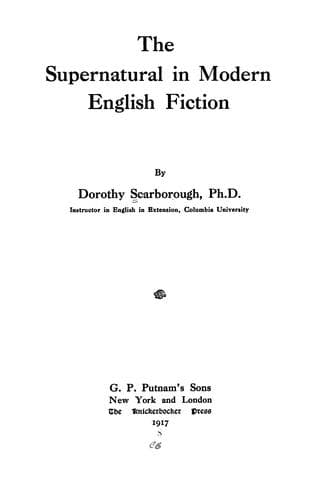
The Supernatural in Modern English FictionScarborough, Dorothy
History
The Supernatural in Modern English Fiction
Scarborough, Dorothy
English fiction -- History and criticism; Supernatural in literature
Besides the bringing of supernaturalism definitely into fiction, which
is a distinct gain, we find other benefits as well. In Gothicism,
if we examine closely, we find the beginnings of many forms of
supernaturalism that are crude here, but that are to develop into
special power in later novels and short stories. The terror novel
excites our ridicule in some respects, yet, like other things that
arouse a certain measure of laughter, it has great value. It seems a
far cry from the perambulating statue in _Otranto_ to Lord Dunsany's
jade gods that move with measured, stony steps to wreak a terrible
vengeance on mortals who have defied them, but the connection may be
clearly enough seen. The dreadful experiments by which Frankenstein's
monster is created are close akin to the revolting vivisections of
Wells's Dr. Moreau, or the operations described by Arthur Machen
whereby human beings lose their souls and become diabolized, given
over utterly to unspeakable evil. The psychic elements in _Zofloya_
are crudely conceived, yet suggestive of the psychic horrors of the
work of Blackwood, Barry Pain, and Theodore Dreiser, for example. The
animal supernaturalism only lightly touched on in Gothic novels is to
be elaborated in the stories of ghostly beasts like those by Edith
Wharton, Kipling, Ambrose Bierce, and others. In fact, the greater
number of the forms of the supernatural found in later fiction and
the drama are discoverable, in germ at least, in Gothic romance. The
work of this period gave a tremendous impetus to the uncanny elements
of romanticism and the effect has been seen in the fiction and drama
and poetry since that time. Its influence on the drama of its day
may be seen in Walpole's _Mysterious Mother_ and Lewis's _Castle
Specter_. Thomas Lovell Beddoe's extraordinary tragedy, _Death's Jest
Book_, while largely Elizabethan in materials and method, is closely
related to the Gothic as well. It would be impossible to understand or
appreciate the supernatural in the nineteenth-century literature and
that of our own day without a knowledge of the Gothic to which most of
it goes back. Like most beginnings, Gothicism is crude in its earlier
forms, and conventional in the flood of imitations that followed the
successful attempts. But it is really vital and most of the ghostly
fiction since that time has lineally descended from it rather than from
the supernaturalism of the epic or of the drama.
CHAPTER II
Later Influences
Public-domain text, read in full here on John Shaqi.
Reviews
Reviews
No reviews yet
Be the first to share your thoughts on this work.
Join the Discussion
Join the discussion
Sign in to leave a comment or review.
Sign InorCreate an account