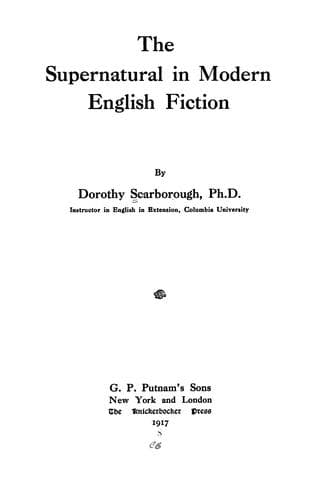
The Supernatural in Modern English FictionScarborough, Dorothy
History
The Supernatural in Modern English Fiction
Scarborough, Dorothy
English fiction -- History and criticism; Supernatural in literature
Maupassant's stories of madness, akin to Poe's analyses of mental
decay, of the slow corruption of the brain, are among his most dreadful
triumphs of style, and have influenced various English stories of
insanity. In Maupassant's own tottering reason we find the tragic
explanation of his constant return to this type of story. Such tales as
_Mad_, where a husband goes insane from doubt of his wife; _Madness_,
where a man has a weird power over human beings, animals, and even
inanimate objects, making them do his will, so that he is terrified
of his own self, of what his horrible hands may do mechanically;
_Cocotte_, where the drowned dog, following its master a hundred miles
down the river, drives him insane; _The Tress_, a curdling story of the
relation between insanity and the supernatural, so that one is unable
to say which is cause and which effect, illustrate Maupassant's unusual
association between madness and uncanny fiction. Who but Maupassant
could make a story of ghastly hideousness out of a parrot that swears?
As Maupassant was influenced by Poe, in both subject matter and
technique, so he has affected the English writers since his time in
both plot material and treatment of the supernatural. And as his _La
Horla_ strongly reflects FitzJames O'Brien's _What Was It? A Mystery_
that anticipated it by a number of years, so it left its inevitable
impress on Bierce's _The Damned Thing_ and succeeding stories of
supernatural invisibility. A recent story by Katherine Fullerton
Gerould, _Louquier's Third Act_, seems clearly to indicate the De
Maupassant influence, reflecting the method and motifs of _La Horla_
and _The Coward_. Maupassant's tales have a peculiar horror possessed
by few, partly because of his undoubted genius and partly the result of
his increasing madness.
Other French writers have also influenced the uncanny story in English.
Théophile Gautier has undoubtedly inspired various tales, such as _The
Mummy's Foot_, by Jessie Adelaide Weston, which is the match, though
not in beauty or form, to his little masterpiece of that title. A.
Conan Doyle's _Lot No. 249_, a horrible story of a reanimated mummy,
bears an unquestionable resemblance to Gautier's _The Romance of
the Mummy_ as well as _The Mummy's Foot_, though Poe's _A Word with
a Mummy_, a fantastic story emphasizing the science of miraculous
embalming of living persons so that they would wake to life after
thousands of years, preceded it. Something of the same theme is also
used by F. Marion Crawford,[45] where the bodies in the old studio
awake to menacing life. This motif illustrates the prevalence of the
Oriental material in recent English fiction. Gautier's _La Morte
Amoureuse_ has exercised suggestive power over later tales, such as
Crawford's vampire story,[46] though it is significant to recall that
Poe's _Berenice_ preceded Gautier's story by a year, and the latter
must have known Poe's work.
[45] In _Khaled_.
[46] _For the Blood Is the Life._
Public-domain text, read in full here on John Shaqi.
Reviews
Reviews
No reviews yet
Be the first to share your thoughts on this work.
Join the Discussion
Join the discussion
Sign in to leave a comment or review.
Sign InorCreate an account