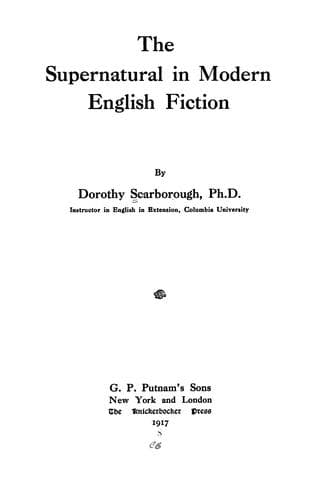
The Supernatural in Modern English FictionScarborough, Dorothy
History
The Supernatural in Modern English Fiction
Scarborough, Dorothy
English fiction -- History and criticism; Supernatural in literature
[114] By N. M. Lloyd.
The modern ghost has power over certain localities rather than mere
houses or apartments. If the house he calls his own is torn down, he
bides his time and haunts the new structure built on the same spot.
Or if no new house goes up, he hangs around and haunts the vacant
lot, which is a more reprehensible procedure than the ordinary habits
of spooks. One story concerns a house so persistently ghosted that
its owner took it down section by section, trying to arrive at the
location of the curse, but to no avail. When the whole building had
been razed and the site plowed over, the ghost undiscouraged haunted
merrily on. Then the owner left in disgust. Algernon Blackwood is
fond of situations where localities are haunted by evil spirits,[115]
where a whole village is inhabited by the ghosts of long-dead witches,
or _Secret Worship_ that relates the experience of a man who wanders
within the limits of a place made horrible by devil-worshipers,
long-dead, but life-like, and inhabiting a house that has been torn
down years before but appears as usual, where they entrap the souls of
the living for their fiendish sacrifice. Another[116] is the record of
a spirit of frightful evil that haunts a house built on the spot where
an older house once stood, whose diabolism lingers on to curse the
living. The spirit that haunts a locality rather than one room or house
has a more malignant power than the more restricted ghost and this adds
a new element of definite supernaturalism to modern fiction. But as
houses are so much less permanent now than formerly, ghosts would be at
a terrible disadvantage if they had to be evicted every time a building
was torn down.
[115] As in _Ancient Sorceries_.
[116] _A Psychic Invasion._
* * * * *
Ghostly psychology is a fascinating study. The development of spectral
personality is one of the evident facts gained from a historical survey
of supernatural fiction. The modern ghost has more individuality,
more distinctiveness, in the main, than his forbears. The ghosts of
medievalism, of ancient superstition, and the drama were for the most
part pallid, colorless beings in character as in materialization.
The ancient ghosts were more mournful than the moderns, since the
state of the dead in early times was by no means enviable. The most
one could hope for then was Hades, while the spirits who hadn't been
buried couldn't find entrance even there but were forced by relentless
spectral police to keep forever moving. The Christian religion
furnishes a more cheerful outlook, so in later manifestations the gloom
is considerably lightened. Yet even so the Gothic ghosts were morbid,
low-minded specters not much happier than the unlucky wights they felt
it their business to haunt. Their woe-begone visages, their clanking
chains, and other accompaniments of woe betokened anything but cheer.
Public-domain text, read in full here on John Shaqi.
Reviews
Reviews
No reviews yet
Be the first to share your thoughts on this work.
Elsewhere in the archive
Join the Discussion
Join the discussion
Sign in to leave a comment or review.
Sign InorCreate an account