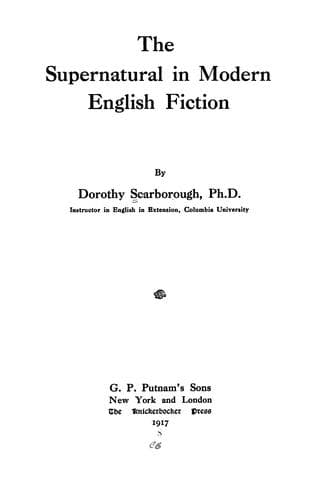
The Supernatural in Modern English FictionScarborough, Dorothy
History
The Supernatural in Modern English Fiction
Scarborough, Dorothy
English fiction -- History and criticism; Supernatural in literature
lover's hands before her face. The skeleton is found chained by the
waist inside the ancient wall. Blackwood's _Ancient Sorceries_ depicts
the ghosts of buried life, of a whole village enchanted by the past
and living over again the witchcraft of the long ago. As John Silence,
the psychic doctor, tells of the Englishman who drops casually into the
village and is drawn into the magic:
Vesin was swept into the vortex of forces arising out of the
intense activities of a past life and lived over again a scene in
which he had often played a part centuries ago. For strong actions
set up forces that are so slow to exhaust themselves that they
may be said in a sense never to die. In this case they were not
complete enough to render the illusion perfect, so the little man
was confused between the present and the past.
[142] In _Mr. Eberdeen's House_.
That story of unusual psychical experience, _An Adventure_, by two
Oxford women, can be explained on no other basis than some such theory
as this. The book claims to be a truthful account of a happening
at Versailles, where two English women, teachers and daughters of
clergymen, saw in broad daylight the ghosts of the past, the figures of
Marie Antoinette and her court. The writers offer the explanation that
they stumbled into a sort of pocket of the unhappy queen's memories
and saw the past relived before their eyes because she had felt it so
keenly and vividly long ago. Other instances might be given, but these
are sufficient to illustrate the type. Such stories have a curious
haunting power and are among the most effective narratives. The idea is
modern and illustrates the complexity of later thought as compared with
the simplicity of earlier times.
A comparative study of ghost stories leads one to the conclusion
that the ghost is the most modern of ancients and the most ancient
of moderns. In some respects the present specter is like and in some
unlike the previous forms. Ghosts, whether regarded as conjective or
purely subjective, are closely related to the percipients' thoughts.
Primitive times produced a primitive supernaturalism and the gradual
advance in intellectual development has brought about a heightening and
complexity of the weird story. 'Tis in ourselves that ghosts are thus
and so!
Public-domain text, read in full here on John Shaqi.
Reviews
Reviews
No reviews yet
Be the first to share your thoughts on this work.
Elsewhere in the archive
Join the Discussion
Join the discussion
Sign in to leave a comment or review.
Sign InorCreate an account