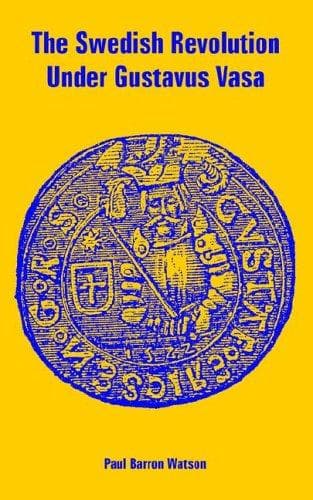
The Swedish Revolution Under Gustavus VasaWatson, Paul Barron
History
The Swedish Revolution Under Gustavus Vasa
Watson, Paul Barron
Gustav I Vasa, King of Sweden, 1496-1560; Sweden -- History -- Gustav I Vasa, 1523-1560
burghers, that the people at large might choose of the two evils that
which pleased them best. The result was that Karl Knutsson was elected
king. From this time till his death, in 1470, he was in perpetual
warfare with the king of Denmark, with the Swedish priesthood, who had
now grown fat under Danish rule and wished to continue so, and with the
hostile party among the magnates. Twice he was forced to lay down the
crown only to take it up again. Throughout his reign, though in some
regards a despot, he was, at all events, the champion of the Swedish
magnates as opposed to those who favored the continuance of foreign
rule. In 1470 he died, after having intrusted Stockholm Castle to his
nephew, Sten Sture. The dissension that now reigned throughout the land
was great. On one side were the powerful Vasa and Oxenstjerna families,
striving to put Christiern I. of Denmark on the throne. On the other
side was Sten Sture, the Tott, Gyllenstjerna, Bonde, Bjelke, and Natt
och Dag families, supported by the burgher element in Stockholm and the
peasantry of Dalarne. With such odds on their side the issue could not
long be doubtful. At a general diet held in 1471, Sten Sture was chosen
regent of the kingdom. It is impossible to overrate the significance of
this event. This was the first time that the burgher element played an
important part in the election of Sweden's ruler. The peasantry had once
before been prominent, but so long as the oligarchy held firmly
together, their actual influence had been slight. Now the ranks of the
oligarchy were broken. One party looked for supporters in Denmark and in
the Church; the other, now gaining the upper hand, was distinctly the
party of the people. The very name of regent, which was granted to Sten
Sture, bears witness to the popular character of the movement. And this
was destined to be the tendency of the current during the next
half-century. There were many difficulties, however, with which the
patriot party had to contend. In the first place, the Swedish party was
in lack of funds. An enormous proportion of the kingdom was exempt from
taxes, being held by magnates, who by this time claimed the right to
inherit their fathers' fiefs with all the ancient privileges, but
without the ancient duty to render military service. In this juncture
war broke out with Russia, at the same time that the kingdom was
continually harassed by Christiern, king of Denmark. It was clear that
some new mode must be discovered for raising money. The peasantry were
already groaning under a heavier load than they could bear. Sten
therefore turned to some of the magnates, and demanded of them that they
should give up a portion of their fiefs. They of course resisted, and
his whole reign was occupied with a struggle to make them yield. In 1481
Christiern, king of Denmark, died, and was succeeded by his son Hans.
The efforts of Sten Sture to curb the magnates had rendered him so
Public-domain text, read in full here on John Shaqi.
Reviews
Reviews
No reviews yet
Be the first to share your thoughts on this work.
Join the Discussion
Join the discussion
Sign in to leave a comment or review.
Sign InorCreate an account