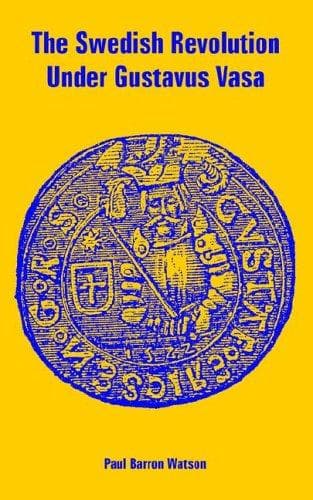
The Swedish Revolution Under Gustavus VasaWatson, Paul Barron
History
The Swedish Revolution Under Gustavus Vasa
Watson, Paul Barron
Gustav I Vasa, King of Sweden, 1496-1560; Sweden -- History -- Gustav I Vasa, 1523-1560
The contest has its chief value in the opportunity that it gives us to
study the methods of the king. From first to last it was a blow at
popery and the temporal supremacy of Rome. Each question was worded with
the very purpose of offering insult to the Church. Take for example the
second question: whether the dominion of the pope and his satellites is
for or against Christ. The monarch could not have thrown the question
into a more irritating form. Certainly Galle showed forbearance in
arguing the point at all. His answer was an appeal to history. From the
days of Gregory popes had enjoyed vast riches along with temporal power;
this showed that they were justified in possessing wealth.[143] Galle's
logic on the subject is not altogether clear. Petri's was somewhat
better. Christ had distinctly told the Apostles that his kingdom was not
of this world,[144] and Paul had declared that the Apostles were not to
be masters but servants.[145] Petri then broke out into a tirade against
his opponent's view. What right, he asked, had Galle to set up Gregory
against Christ and Paul? "What authority has he to expound the Word of
God according to the deeds of petty men? Rather, I conceive, are the
deeds of men to be judged according to the Word of God."[146] To an
assertion by Galle that the Church had held temporal power for the last
twelve centuries, Petri answered: "For that matter, the Word of God has
lasted still longer than twelve centuries.... However, the question is
not how old the thing is, but how right it is. The devil is old, and
none the better for it. That bishops are temporal lords is contrary to
the Word of God; and the longer they have been so, the worse for them.
Princes and emperors have granted the pope vast privileges, by which in
course of time he has become their master, till now all men bow down and
kiss his feet. Where he was given an inch, he has taken an ell....
Christ told Saint Peter to feed his lambs. But the popes with their
satellites have long since ceased to feed Christ's lambs, and for
centuries have done naught but fleece and slaughter them, not acting
like faithful shepherds, but like ravening wolves."[147] This vehement
language must have pleased the king. If bishops were not entitled to
worldly goods, it was an easy task to confiscate their property to the
crown. A like incentive called forth the question: whether any authority
can be found in the Bible for monastic life. The question, in that form,
permitted no reference to the Fathers. So Galle cited the command of
Jesus: "Go, sell all that thou hast, and give to the poor;" and he
further commended monastic life as a step on the way to heaven.[148]
Petri replied that monks did not sell all they had and give to the poor,
but clung fast to their possessions, bringing vast treasures into the
monasteries with them.[149]
Public-domain text, read in full here on John Shaqi.
Reviews
Reviews
No reviews yet
Be the first to share your thoughts on this work.
Elsewhere in the archive
Join the Discussion
Join the discussion
Sign in to leave a comment or review.
Sign InorCreate an account