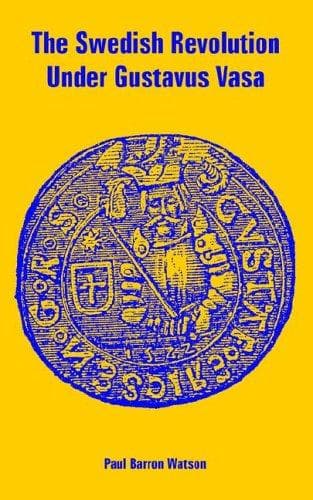
The Swedish Revolution Under Gustavus VasaWatson, Paul Barron
History
The Swedish Revolution Under Gustavus Vasa
Watson, Paul Barron
Gustav I Vasa, King of Sweden, 1496-1560; Sweden -- History -- Gustav I Vasa, 1523-1560
No sooner did Christiern
see her, than his whole soul burned within him. He seized her hand, and
led off the dance in company with his fair enchanter. Rapture filled his
soul; and when the ball was over, Dyveke was secretly detained and
brought to Christiern's bed. This incident had a far-reaching influence
on Christiern's later life. Though already betrothed to the sister of
Charles V., his passion for Dyveke did not pass away. He erected a
palace at Opslo, and lived there with his mistress until recalled to
Copenhagen, when he took her with him. The most singular feature in this
whole intrigue is that the royal voluptuary was from the outset under
the absolute sway, not of the fair Dyveke, but of her mother, Sigbrit, a
low, cunning, intriguing woman of Dutch origin, who followed the couple
to the royal palace at Opslo, and afterwards accompanied them to
Stockholm, the complete ruler of her daughter's royal slave. On the
accession of Christiern to the throne, he resolved, at the instance of
this woman, to add the Swedish kingdom to his dominions. In order to
comprehend the measures which he adopted, it will be necessary to trace
events in Sweden since the death of Hans.
The Danish party, in no way daunted by their futile effort to secure the
regency of Sweden, had kept up continuous negotiations with their
friends in Denmark, with the object ultimately to place the king of
Denmark on the throne. Owing, however, to the manifest and growing
popularity of the young Sture, they deemed it wise to wait for a more
auspicious moment before making open demonstration, and for the time
being yielded to the regent with the best grace they could command. The
thing which they most needed, in order to counteract the influence of
the chivalric young Sture, was the infusion of new life among their
ranks. The archbishop and Erik Trolle both were old, and, though in the
full vigor of their intellectual ability, lacked the energy and
endurance required to carry on a policy of active war. It was resolved,
therefore, to throw the burden of leadership on younger shoulders. There
was at this time in Rome a man who seemed to possess more qualifications
than any other for the post. This was Gustaf Trolle. He was young,
highly educated, energetic, and above all a son of Erik Trolle, the
powerful leader of the Danish faction. He had seen much of the world,
and had lived on terms of familiarity with some of the greatest men in
Europe. But his whole power of usefulness was lost through his
inordinate personal and family pride. Weighted down by the sense of his
own importance, with haughty overbearing manners, and a dogged obstinacy
in dealing with his inferiors, he was the last man in the world to be
successful as a party leader. Yet it was on this man that the Danish
party fixed its hopes. The matter first took shape on the 31st of
August, 1514, when the archbishop in conversation with Sture suggested
that old age was now coming on so fast that he desired to resign his
Public-domain text, read in full here on John Shaqi.
Reviews
Reviews
No reviews yet
Be the first to share your thoughts on this work.
Join the Discussion
Join the discussion
Sign in to leave a comment or review.
Sign InorCreate an account