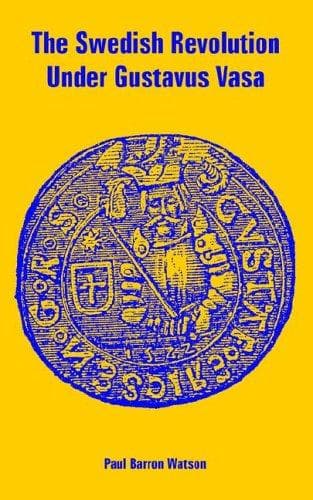
The Swedish Revolution Under Gustavus VasaWatson, Paul Barron
History
The Swedish Revolution Under Gustavus Vasa
Watson, Paul Barron
Gustav I Vasa, King of Sweden, 1496-1560; Sweden -- History -- Gustav I Vasa, 1523-1560
Another personage at court, with whom we have already become acquainted,
was Hemming Gad. Although of humble birth, this man had received a
careful education, and during twenty years of his early life had held
the post of Swedish ambassador at the court of Rome. On his return to
Sweden he had been elected bishop of the diocese of Linköping, but had
never entered on his duties owing to the opposition of the pope. He was
not indeed a priest. Diplomacy was above all else the field in which he
shone. A warm supporter of the Stures, he had more than once averted
trouble by his powers of conciliation, and was regarded as an
indispensable servant of the people's cause. Fearless, eloquent,
untiring, conciliatory, persuasive, perhaps not too conscientious, he
was the most influential person in the Cabinet and one of the very
foremost statesmen of his time. It was to this man, then seventy-four
years of age, that the care of the young Gustavus was intrusted when he
came to court.
Affairs at this time were in a state of great confusion. King Hans of
Denmark had died a year before, and after several months of hostile
demonstration had been succeeded by his son. This person, known as
Christiern II., was as vile a monster as ever occupied a throne. Gifted
by nature with a powerful frame, tall, burly, with large head and short
thick neck, broad forehead and high cheek-bones, prominent nose, firmly
compressed lips, a plentiful supply of shaggy hair on his head and face,
heavy overhanging eyebrows, his eyes small, deep-set, and fierce,--his
appearance furnished an excellent index to his character. Firm,
courageous, by no means wanting in intellect or executive ability, he
was sensual, gross, and cruel. Though often full of hilarity and hearty
animal spirits, there was ever hanging over him a cloud of melancholy,
which occasionally settled on him with such weight as to rob him wholly
of his reason. At such times he seemed transformed into some fierce
monster with an insatiable thirst for blood. When a mere boy in the
royal palace at Copenhagen, he is said to have amused himself by
midnight orgies about the city's streets.[16] He was well educated,
however, and early became a useful adjunct to his father. At twenty-one
he displayed much bravery in an assault which Hans then made on
Stockholm; and a few years later he became his father's deputy in the
government of Norway. While there, his secretary one day came to him and
portrayed in glowing terms the beauty of a maiden who had dazzled him in
Bergen. The sensitive heart of Christiern at once was fired. He left his
castle at Opslo without a moment's waiting, and, crossing hill and vale
without a murmur, hastened to feast his eyes on the fair Dyveke. Being
of a romantic turn of mind, he resolved to see her first amidst all the
fashion of the town. A splendid ball was therefore held, to which the
aristocracy were bidden with their daughters. Among the guests was the
renowned Dyveke, who outshone all in beauty.
Public-domain text, read in full here on John Shaqi.
Reviews
Reviews
No reviews yet
Be the first to share your thoughts on this work.
Join the Discussion
Join the discussion
Sign in to leave a comment or review.
Sign InorCreate an account