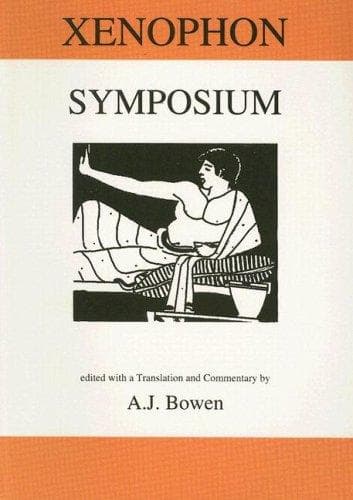
Classical literature; Philosophy, Ancient; Socrates, 470 BC-399 BC
Soc. How is it possible that things, in no respect resembling one
another, should each and all be beautiful? (4)
(4) See "Mem." III. viii. 5, quoted by Galen, "de Usu Part." i. 370.
Crit. Of course it is, God bless me! if well constructed by the hand
of man to suit the sort of work for which we got them, or if naturally
adapted to satisfy some want, the things in either case are beautiful.
Soc. Can you tell me, then, what need is satisfied by our eyes?
Crit. Clearly, the need of vision.
Soc. If so, my eyes are proved at once to be more beautiful than yours.
Crit. How so?
Soc. Because yours can only see just straight in front of them, whereas
mine are prominent and so projecting, they can see aslant. (5)
(5) Or, "squint sideways and command the flanks."
Crit. And amongst all animals, you will tell us that the crab has
loveliest eyes? (6) Is that your statement?
(6) Or, "is best provided in respect of eyeballs."
Soc. Decidedly, the creature has. And all the more so, since for
strength and toughness its eyes by nature are the best constructed.
Crit. Well, let that pass. To come to our two noses, which is the more
handsome, yours or mine?
Soc. Mine, I imagine, if, that is, the gods presented us with noses for
the sake of smelling. Your nostrils point to earth; but mine are spread
out wide and flat, as if to welcome scents from every quarter.
Crit. But consider, a snubness of the nose, how is that more beautiful
than straightness? (7)
(7) Or, "your straight nose." Cf. Plat. "Theaet." 209 C: Soc. "Or, if
I had further known you not only as having nose and eyes, but as
having a snub nose and prominent eyes, should I have any more
notion of you than myself and others who resemble me?" Cf. also
Aristot. "Pol." v. 9, 7: "A nose which varies from the ideal of
straightness to a hook or snub may still be a good shape and
agreeable to the eye; but if the excess be very great, all
symmetry is lost, and the nose at last ceases to be a nose at all
on account of some excess in one direction or defect in the other;
and this is true of every other part of the human body. The same
law of proportion holds in states."--Jowett.
Soc. For this good reason, that a snub nose does not discharge the
office of a barrier; (8) it allows the orbs of sight free range of
vision: whilst your towering nose looks like an insulting wall of
partition to shut off the two eyes. (9)
(8) Or, "the humble snub is not a screen or barricade."
(9) Cf. "Love's Labour Lost," v. 2. 568: Boyet. "Your nose says no,
you are not, for it stands too right"; also "The Song of Solomon,"
vii. 4: "Thy nose is the tower of Lebanon, which looketh toward
Damascus."
As to the mouth (proceeded Critobulus), I give in at once; for, given
mouths are made for purposes of biting, you could doubtless bite off a
much larger mouthful with your mouth than I with mine.
Public-domain text, read in full here on John Shaqi.
Reviews
Reviews
No reviews yet
Be the first to share your thoughts on this work.
Join the Discussion
Join the discussion
Sign in to leave a comment or review.
Sign InorCreate an account