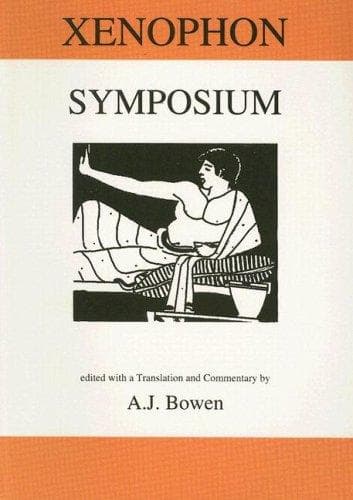
Classical literature; Philosophy, Ancient; Socrates, 470 BC-399 BC
Soc. Yes, and you will admit, perhaps, that I can give a softer kiss
than you can, thanks to my thick lips.
Crit. It seems I have an uglier mouth than any ass.
Soc. And here is a fact which you will have to reckon with, if further
evidence be needed to prove that I am handsomer than you. The naiads,
nymphs, divine, have as their progeny Sileni, who are much more like
myself, I take it, than like you. Is that conclusive?
Nay, I give it up (cried Critobulus), I have not a word to say in
answer. I am silenced. Let them record the votes. I fain would know at
once what I must suffer or must pay. (10) Only (he added) let them vote
in secret. (11) I am afraid your wealth and his (Antisthenes') combined
may overpower me.
(10) For this formula see "Dict. Ant." {timema}. Cf. "Econ." xi. 25;
Plat. "Apol." 36 B; "Statesm." 299 A; "Laws," freq.; Dem. 529. 23;
533. 2.
(11) And not as in the case described (Thuc. iv. 74), where the people
(at Megara) were compelled to give sentence on the political
opponents of the oligarchs by an open vote. Cf. Lysias, 133, 12,
{ten de psephon ouk eis kadiskous, alla phaneran epi tas trapezas
tautas dei tithenai}.
Accordingly the boy and girl began to register the votes in secret,
while Socrates directed the proceedings. He would have the lamp-stand
(12) this time brought close up to Critobulus; the judges must on no
account be taken in; the victor in the suit would get from the two
judges, not a wreath of ribands (13) for a chaplet, but some kisses.
(12) {ton lukhnon} here, above, S. 2, {ton lamptera}. Both, I take it,
are oil-lamps, and differ merely as "light" and "lamp."
(13) Cf. Plat. "Symp." 213; "Hell." V. i. 3.
When the urns were emptied, it was found that every vote, without
exception, had been cast for Critobulus. (14)
(14) Lit. "When the pebbles were turned out and proved to be with
Critobulus, Socrates remarked, 'Papae!'" which is as much to say,
"Od's pity!"
Whereat Socrates: Bless me! you don't say so? The coin you deal in,
Critobulus, is not at all like that of Callias. His makes people just;
whilst yours, like other filthy lucre, can corrupt both judge and jury.
(15)
(15) {kai dikastas kai kritas}, "both jury and presiding judges," i.e.
the company and the boy and girl.
VI
Thereupon some members of the party called on Critobulus to accept the
meed of victory in kisses (due from boy and girl); others urged him
first to bribe their master; whilst others bandied other jests. Amidst
the general hilarity Hermogenes alone kept silence.
Whereat Socrates turned to the silent man, and thus accosted him:
Hermogenes, what is a drunken brawl? Can you explain to us?
He answered: If you ask me what it is, I do not know, but I can tell you
what it seems to me to be.
Soc. That seems as good. What does it seem?
Her. A drunken brawl, in my poor judgment, is annoyance caused to people
over wine.
Public-domain text, read in full here on John Shaqi.
Reviews
Reviews
No reviews yet
Be the first to share your thoughts on this work.
Join the Discussion
Join the discussion
Sign in to leave a comment or review.
Sign InorCreate an account