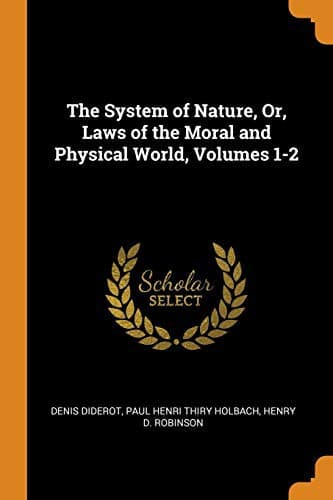
The System of Nature, or, the Laws of the Moral and Physical World. Volume 1 — John Shaqi
The System of Nature, or, the Laws of the Moral and Physical World. Volume 1Holbach, Paul Henri Thiry, baron d'
Religion
The System of Nature, or, the Laws of the Moral and Physical World. Volume 1
Holbach, Paul Henri Thiry, baron d'
Materialism; Philosophy and religion; Psychology
Produced by Freethought Archives and Distributed Proofreaders
THE SYSTEM OF NATURE, VOLUME I (of II)
By Paul Henri Thiery (Baron d'Holbach)
Introduction by Robert D. Richardson, Jr.
PRODUCTION NOTES: First published in French in 1770 under the pseudonym
of Mirabaud. This e-book based on a facsimile reprint of an English
translation originally published 1820-21. This e-text covers the first
of the original two volumes.
INTRODUCTION
Paul Henri Thiery, Baron d'Holbach (1723-1789), was the center of the
radical wing of the _philosophes_. He was friend, host, and patron to
a wide circle that included Diderot, D'Alembert, Helvetius, and Hume.
Holbach wrote, translated, edited, and issued a stream of books and
pamphlets, often under other names, that has made him the despair of
bibliographers but has connected his name, by innuendo, gossip, and
association, with most of what was written in defense of atheistic
materialism in late eighteenth-century France.
Holbach is best known for _The System of Nature_ (1770) and deservedly,
since it is a clear and reasonably systematic exposition of his main
ideas. His initial position determines all the rest of his argument.
"There is not, there can be nothing out of that Nature which includes
all beings." Conceiving of nature as strictly limited to matter and
motion, both of which have always existed, he flatly denies that there
is any such thing as spirit or a supernatural. Mythology began, Holbach
claims, when men were still in a state of nature and at the point when
wise, strong, and for the most part benign men were arising as leaders
and lawgivers. These leaders "formed discourses by which they spoke to
the imaginations of their willing auditors," using the medium of poetry,
because it "seem{ed} best adapted to strike the mind." Through poetry,
then, and by means of "its images, its fictions, its numbers, its rhyme,
its harmony... the entire of nature, as well as all its parts, was
personified, by its beautiful allegories." Thus mythology is given
an essentially political origin. These early poets are literally
legislators of mankind. "The first institutors of nations, and their
immediate successors in authority, only spoke to the people by fables,
allegories, enigmas, of which they reserved to themselves the right
of giving an explanation." Holbach is rather condescending about the
process, but since mythology is a representation of nature itself, he
is far more tolerant of mythology than he is of the next step. "Natural
philosophers and poets were transformed by leisure into metaphysicians
and theologians," and at this point a fatal error was introduced: the
theologians made a distinction between the power of nature and nature
itself, separated the two, made the power of nature prior to nature, and
called it God. Thus man was left with an abstract and chimerical being
on one side and a despoiled inert nature, destitute of power, on the
other.
Public-domain text, read in full here on John Shaqi.
Reviews
Reviews
No reviews yet
Be the first to share your thoughts on this work.
Join the Discussion
Join the discussion
Sign in to leave a comment or review.
Sign InorCreate an account