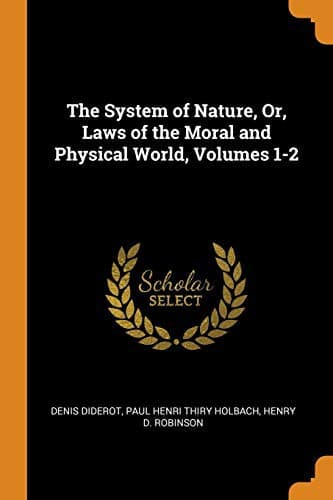
The System of Nature, or, the Laws of the Moral and Physical World. Volume 1Holbach, Paul Henri Thiry, baron d'
Religion
The System of Nature, or, the Laws of the Moral and Physical World. Volume 1
Holbach, Paul Henri Thiry, baron d'
Materialism; Philosophy and religion; Psychology
If particles of iron, sulphur, and water be mixed together, these
bodies thus capacitated to act on each other, are heated by degrees, and
ultimately produce a violent combustion. If flour be wetted with water,
and the mixture closed up, it will be found, after some lapse of time,
(by the aid of a microscope) to have produced organized beings that
enjoy life, of which the water and the flour were believed incapable:
it is thus that inanimate matter can pass into life, or animate matter,
which is in itself only an assemblage of motion.
Reasoning from analogy, which the philosophers of the present day do not
hold incompatible, the production of a man, independent of the ordinary
means, would not be more astonishing than that of an insect with flour
and water. Fermentation and putrid substances, evidently produce living
animals. We have here the principle; with proper materials, principles
can always be brought into action. That generation which is styled
_uncertain_ is only so for those who do not reflect, or who do not
permit themselves, attentively, to observe the operations of Nature.
The generative of motion, and its developement, as well as the energy of
matter, may be seen everywhere; more particularly in those unitions in
which fire, air, and water, find themselves combined. These elements, or
rather these mixed bodies, are the most volatile, the most fugitive
of beings; nevertheless in the hands of Nature, they are the essential
agents employed to produce the most striking phenomena. To these we must
ascribe the effects of thunder, the eruption of volcanoes, earthquakes,
&c. Science offers to our consideration an agent of astonishing force,
in gunpowder, the instant it comes in contact with fire. In short, the
most terrible effects result from the combination of matter, which is
generally believed to be dead and inert.
These facts prove, beyond a doubt, that motion is produced, is
augmented, is accelerated in matter, without the help of any exterior
agent: therefore it is reasonable to conclude that motion is the
necessary consequence of immutable laws, resulting from the essence,
from the properties existing in the different elements, and the
various combinations of these elements. Are we not justified, then,
in concluding, from these precedents, that there may be an infinity of
other combinations, with which we are unacquainted, competent to produce
a great variety of motion in matter, without being under the necessity
of having recourse, for the explanation, to agents who are more
difficult to comprehend than even the effects which are attributed to
them?
Public-domain text, read in full here on John Shaqi.
Reviews
Reviews
No reviews yet
Be the first to share your thoughts on this work.
Join the Discussion
Join the discussion
Sign in to leave a comment or review.
Sign InorCreate an account