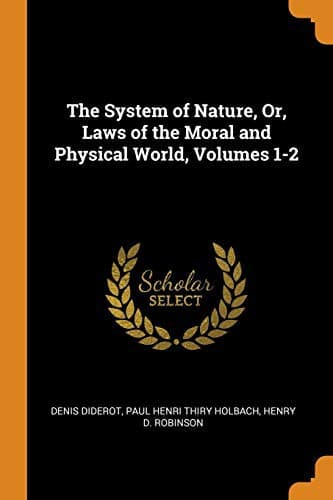
The System of Nature, or, the Laws of the Moral and Physical World. Volume 1Holbach, Paul Henri Thiry, baron d'
Religion
The System of Nature, or, the Laws of the Moral and Physical World. Volume 1
Holbach, Paul Henri Thiry, baron d'
Materialism; Philosophy and religion; Psychology
Had man but paid proper attention to what passed under his review, he
would not have sought out of Nature, a power distinguished from herself,
to set her in action, and without which he believes she cannot move. If,
indeed, by Nature is meant a heap of dead matter, destitute of peculiar
qualities purely passive, we must unquestionably seek out of this Nature
the principle of her motion. But if by Nature be understood, what it
really is, a whole, of which the numerous parts are endowed with various
properties, which oblige them to act according to these properties;
which are in a perpetual ternateness of action and reaction; which
press, which gravitate towards a common center, whilst others depart
from and fly off towards the periphery, or circumference; which attract
and repel; which by continual approximation and constant collision,
produce and decompose all the bodies we behold; then, I say, there is
no necessity to have recourse to supernatural powers, to account for the
formation of things, and those extraordinary appearances which are the
result of motion.
Those who admit a cause exterior to matter, are obliged to believe that
this cause produced all the motion by which matter is agitated in giving
it existence. This belief rests on another, namely, that matter could
begin to exist; an hypothesis that, until this moment, has never been
satisfactorily demonstrated. To produce from nothing, or the CREATION,
is a term that cannot give us the least idea of the formation of the
universe; it presents no sense, upon which the mind can rely. In fact,
the human mind is not adequate to conceive a moment of non-existence, or
when all shall have passed away; even admitting this to be a truth, it
is no truth for us, because by the very nature of our organization, we
cannot admit positions as facts, of which no evidence can be adduced
that has relation to our senses; we may, indeed, consent to believe it,
because others say it; but will any rational being be satisfied with
such an admission? Can any moral good spring from such blind assurance?
Is it consistent with sound doctrine, with philosophy, or with reason?
Do we, in fact, pay any respect to the intellectual powers of another,
when we say to him, "I will believe this, because in all the attempts
you have ventured, for the purpose of proving what you say, you have
entirely failed; and have been at last obliged to acknowledge you know
nothing about the matter?" What moral reliance ought we to have on such
people? Hypothesis may succeed hypothesis; system may destroy system: a
new set of ideas may overturn the ideas of a former day. Other
Gallileos may be condemned to death--other Newtons may arise--we may
reason--argue--dispute--quarrel--punish and destroy: nay, we may even
exterminate those who differ from us in opinion; but when we have
done all this, we shall be obliged to fall back upon our original
darkness--to confess, that that which has no relation with our senses,
Public-domain text, read in full here on John Shaqi.
Reviews
Reviews
No reviews yet
Be the first to share your thoughts on this work.
Join the Discussion
Join the discussion
Sign in to leave a comment or review.
Sign InorCreate an account