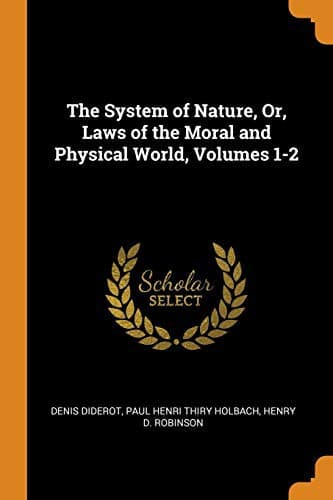
The System of Nature, or, the Laws of the Moral and Physical World. Volume 1Holbach, Paul Henri Thiry, baron d'
Religion
The System of Nature, or, the Laws of the Moral and Physical World. Volume 1
Holbach, Paul Henri Thiry, baron d'
Materialism; Philosophy and religion; Psychology
We know nothing of the elements of bodies, but we know some of their
properties or qualities; and we distinguish their various matter by the
effect or change produced on our senses; that is to say, by the variety
of motion their presence excites in us. In consequence, we discover
in them, extent, mobility, divisibility, solidity, gravity, and inert
force. From these general and primitive properties flow a number
of others, such as density, figure, colour, ponderosity, &c. Thus,
relatively to us, matter is all that affects our senses in any manner
whatever; the various properties we attribute to matter, by which we
discriminate its diversity, are founded on the different impressions we
receive on the changes they produce in us.
A satisfactory definition of matter has not yet been given. Man,
deceived and led astray by his prejudices, formed but vague,
superficial, and imperfect notions concerning it. He looked upon it
as an unique being, gross and passive, incapable of either moving by
itself, of forming combinations, or of producing any thing by its
own energies. Instead of this unintelligible jargon, he ought to have
contemplated it as a _genus_ of beings, of which the individuals,
although they might possess some common properties, such as extent,
divisibility, figure, &c. should not, however, be all ranked in the same
class, nor comprised under the same general denomination.
An example will serve more fully to explain what we have asserted,
throw its correctness into light, and facilitate the application.
The properties common to all matter, are extent, divisibility,
impenetrability, figure, mobility, or the property of being moved in
mass. FIRE, beside these general properties, common to all matter,
enjoys also the peculiar property of being put into activity by a motion
that produces on our organs of feeling the sensation of heat; and by
another, that communicates to our visual organs the sensation of light.
Iron, in common with matter in general, has extent and figure; is
divisible, and moveable in mass: if fire be combined with it in a
certain proportion, the iron acquires two new properties; namely, those
of exciting in us similar sensations of heat and light, which were
excited by the element of fire, but which the iron had not, before its
combination with the igneous matter. These distinguishing properties
are inseparable from matter, and the phenomena that result, may, in the
strictest sense of the word, be said to result necessarily.
Public-domain text, read in full here on John Shaqi.
Reviews
Reviews
No reviews yet
Be the first to share your thoughts on this work.
Join the Discussion
Join the discussion
Sign in to leave a comment or review.
Sign InorCreate an account