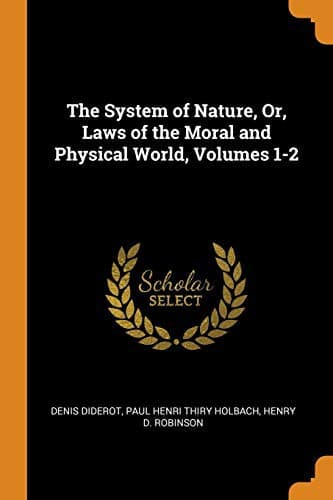
The System of Nature, or, the Laws of the Moral and Physical World. Volume 1Holbach, Paul Henri Thiry, baron d'
Religion
The System of Nature, or, the Laws of the Moral and Physical World. Volume 1
Holbach, Paul Henri Thiry, baron d'
Materialism; Philosophy and religion; Psychology
If we contemplate a little the paths of Nature--if, for a time, we trace
the beings in this Nature, under the different states through which,
by reason of their properties, they are compelled to pass; we shall
discover, that it is to motion, and motion only, that is to be ascribed
all the changes, all the combinations, all the forms, in short, all the
various modifications of matter. That it is by motion every thing that
exists is produced, experiences change, expands, and is destroyed. It
is motion that alters the aspect of beings; that adds to, or takes away
from their properties; which obliges each of them, by a consequence of
its nature, after having occupied a certain rank or order, to quit it,
to occupy another, and to contribute to the generation, maintenance, and
decomposition of other beings, totally different in their bulk, rank,
and essence.
In what experimental philosophers have styled the THREE ORDERS OF
NATURE, that is to say, the _mineral_, the _vegetable_, and _animal_
worlds, they have established, by the aid of motion, a transmigration,
an exchange, a continual circulation in the particles of matter. Nature
has occasion in one place, for those particles which, for a time, she
has placed in another. These particles, after having, by particular
combinations, constituted beings endued with peculiar essences, with
specific properties, with determinate modes of action, dissolve and
separate with more or less facility; and combining in a new manner, they
form new beings. The attentive observer sees this law execute itself, in
a manner more or less prominent, through all the beings by which he is
surrounded. He sees nature full of _erratic germe_, some of which expand
themselves, whilst others wait until motion has placed them in their
proper situation, in suitable wombs or matrices, in the necessary
circumstances, to unfold, to increase, to render them more perceptible
by the addition of other substances of matter analogous to their
primitive being. In all this we see nothing but the effect of motion,
necessarily guided, modified, accelerated or slackened, strengthened or
weakened, by reason of the various properties that beings successively
acquire and lose; which, every moment, infallibly produces alterations
in bodies more or less marked. Indeed, these bodies cannot be, strictly
speaking, the same in any two successive moments of their existence;
they must, every instant, either acquire or lose: in short, they are
obliged to undergo continual variations in their essences, in their
properties, in their energies, in their masses, in their qualities, in
their mode of existence.
Public-domain text, read in full here on John Shaqi.
Reviews
Reviews
No reviews yet
Be the first to share your thoughts on this work.
Join the Discussion
Join the discussion
Sign in to leave a comment or review.
Sign InorCreate an account