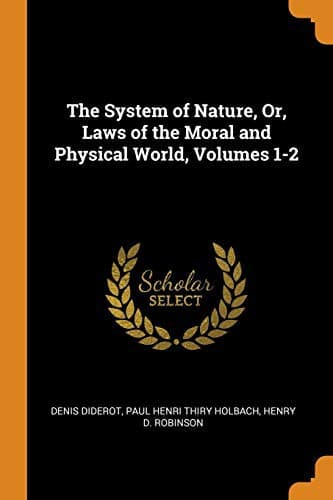
The System of Nature, or, the Laws of the Moral and Physical World. Volume 1Holbach, Paul Henri Thiry, baron d'
Religion
The System of Nature, or, the Laws of the Moral and Physical World. Volume 1
Holbach, Paul Henri Thiry, baron d'
Materialism; Philosophy and religion; Psychology
The same elements, which under certain circumstances serve to nourish,
to strengthen, to maintain the animal, become, under others, the
principles of his weakness, the instruments of his dissolution--of his
death: they work his destruction, whenever they are not in that just
proportion which renders them proper to maintain his existence: thus,
when water becomes too abundant in the body of the animal, it enervates
him, it relaxes the fibres, and impedes the necessary action of the
other elements: thus, fire admitted in excess, excites in him disorderly
motion destructive of his machine: thus, air, charged with principles
not analogous to his mechanism, brings upon him dangerous diseases and
contagion. In fine, the aliments modified after certain modes, in the
room of nourishing, destroy the animal, and conduce to his ruin: the
animal is preserved no longer than these substances are analogous to his
system. They ruin him when they want that just equilibrium that renders
them suitable to maintain his existence.
Plants that serve to nourish and restore animals are themselves
nourished by earth; they expand on its bosom, enlarge and strengthen at
its expense, continually receiving into their texture, by their
roots and their pores, water, air, and igneous matter: water visibly
reanimates them whenever their vegetation or genus of life languishes;
it conveys to them those analogous principles by which they are enabled
to reach perfection: air is requisite to their expansion, and furnishes
them with water, earth, and the igneous matter with which it is charged.
By these means they receive more or less of the inflammable matter; the
different proportions of these principles, their numerous combinations,
from whence result an infinity of properties, a variety of forms,
constitute the various families and classes into which botanists have
distributed plants: it is thus we see the cedar and the hyssop develop
their growth; the one rises to the clouds, the other creep humbly on
the earth. Thus, by degrees, from an acorn springs the majestic oak,
accumulating, with time, its numerous branches, and overshadowing us
with its foliage. Thus, a grain of corn, after having drawn its own
nourishment from the juices of the earth, serves, in its turn, for
the nourishment of man, into whose system it conveys the elements or
principles by which it has been itself expanded, combined, and modified
in such a manner, as to render this vegetable proper to assimilate and
unite with the human frame; that is to say, with the fluids and solids
of which it is composed.
Public-domain text, read in full here on John Shaqi.
Reviews
Reviews
No reviews yet
Be the first to share your thoughts on this work.
Join the Discussion
Join the discussion
Sign in to leave a comment or review.
Sign InorCreate an account