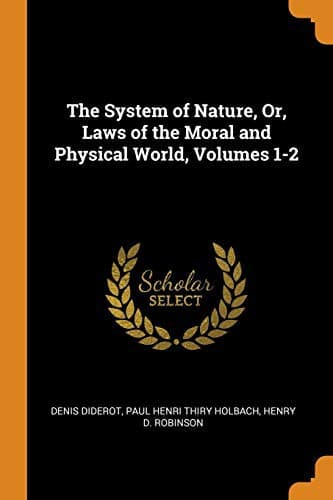
The System of Nature, or, the Laws of the Moral and Physical World. Volume 1 — John Shaqi
The System of Nature, or, the Laws of the Moral and Physical World. Volume 1Holbach, Paul Henri Thiry, baron d'
Religion
The System of Nature, or, the Laws of the Moral and Physical World. Volume 1
Holbach, Paul Henri Thiry, baron d'
Materialism; Philosophy and religion; Psychology
The same elements, the same principles, are found in the formation
of minerals, as well as in their decomposition, whether natural or
artificial. We find that earth, diversely modified, wrought, and
combined, serves to increase their bulk, and give them more or less
density and gravity. Air and water contribute to make their particles
cohere; the igneous matter, or inflammable principle, tinges them with
colour, and sometimes plainly indicates its presence, by the brilliant
scintillation which motion elicits from them. These stones and metals,
these bodies, so compact and solid, are disunited, are destroyed, by
the agency of air, water, and fire; which the most ordinary analysis is
sufficient to prove, as well as a multitude of experience, to which our
eyes are the daily evidence.
Animals, plants, and minerals, after a lapse of time, give back to
Nature; that is to say, to the general mass of things, to the universal
magazine, the elements, or principles, which they have borrowed: The
earth retakes that portion of the body of which it formed the basis
and the solidity; the air charges itself with these parts, that are,
analogous to it, and with those particles which are light and subtle;
water carries off that which is suitable to liquescency; fire, bursting
its chains, disengages itself, and rushes into new combinations with
other bodies.
The elementary particles of the animal, being thus dissolved, disunited,
and dispersed; assume new activity, and form new combinations: thus,
they serve to nourish, to preserve, or destroy new beings; among others,
plants, which arrived at their maturity, nourish and preserve new
animals; these in their turn yielding to the same fate as the first.
Such is the constant, the invariable course, of Nature; such is
the eternal circle of mutation, which all that exists is obliged
to describe. It is thus motion generates, preserves for a time, and
successively, destroys, one part of the universe by the other; whilst
the sum of existence remains eternally the same. Nature, by its
combinations, produces suns, which place themselves in the centre of
so many systems: she forms planets, which, by their peculiar essence,
gravitate and describe their revolutions round these suns: by degrees
the motion is changed altogether, and becomes eccentric: perhaps the day
may arrive when these wondrous masses will disperse, of which man, in
the short space of his existence, can only have a faint and transient
glimpse.
Public-domain text, read in full here on John Shaqi.
Reviews
Reviews
No reviews yet
Be the first to share your thoughts on this work.
Join the Discussion
Join the discussion
Sign in to leave a comment or review.
Sign InorCreate an account