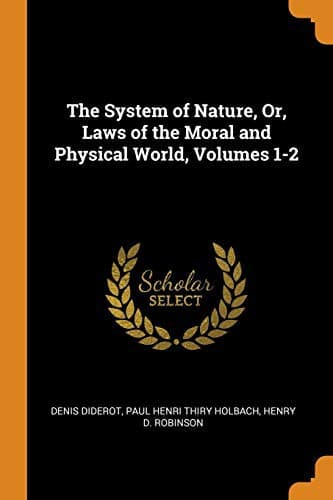
The System of Nature, or, the Laws of the Moral and Physical World. Volume 1Holbach, Paul Henri Thiry, baron d'
Religion
The System of Nature, or, the Laws of the Moral and Physical World. Volume 1
Holbach, Paul Henri Thiry, baron d'
Materialism; Philosophy and religion; Psychology
It is clear, then, that the continual motion inherent in matter, changes
and destroys all beings; every instant depriving them of some of their
properties, to substitute others: it is motion, which, in thus changing
their actual essence, changes also their order, their direction, their
tendency, and the laws which regulate their mode of acting and being:
from the stone formed in the bowels of the earth, by the intimate
combination and close coherence of similar and analogous particles, to
the sun, that vast reservoir of igneous particles, which sheds torrents
of light over the firmament; from the benumbed oyster, to the thoughtful
and active man; we see an uninterrupted progression, a perpetual chain
of motion and combination; from which is produced, beings that only
differ from each other by the variety of their elementary matter--by the
numerous combinations of these elements, from whence springs modes
of action and existence, diversified to infinity. In generation, in
nutrition, in preservation, we see nothing more than matter, variously
combined, of which each has its peculiar motion, regulated by fixed and
determinate laws, which oblige them to submit to necessary changes. We
shall find, in the formation, in the growth, in the instantaneous
life, of animals, vegetables, and minerals, nothing but matter; which
combining, accumulating, aggregating, and expanding by degrees, forms
beings, who are either feeling, living, vegetating, or else destitute
of these faculties; which, having existed some time under one particular
form, are obliged to contribute by their ruin to the production of other
forms.
Thus, to speak strictly, nothing in Nature is either born, or dies,
according to the common acceptation of those terms. This truth was
felt by many of the ancient philosophers. PLATO says, that according to
tradition, "the living were born of the dead, the same as the dead did
come of the living; and that this is the constant routine of Nature." He
adds from himself, "who knows, if to live, be not to die; and if to die,
be not to live?" This was the doctrine of PYTHAGORAS, a man of great
talent and no less note. EMPEDOCLES asserts, "there is neither birth nor
death, for any mortal; but only a combination, and a separation of that
which was combined, and that this is what amongst men they call birth,
and death." Again he remarks, "those are infants, or short-sighted
persons, with very contracted understandings, who imagine any thing is
born, which did not exist before, or that any thing can die or perish
totally."
CHAP. IV.
_Laws of Motion, common to every Being of Nature.--Attraction and
Repulsion.--Inert Force.--Necessity._
Public-domain text, read in full here on John Shaqi.
Reviews
Reviews
No reviews yet
Be the first to share your thoughts on this work.
Join the Discussion
Join the discussion
Sign in to leave a comment or review.
Sign InorCreate an account