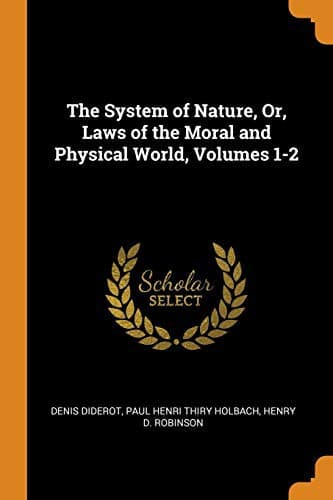
The System of Nature, or, the Laws of the Moral and Physical World. Volume 2Holbach, Paul Henri Thiry, baron d'
Religion
The System of Nature, or, the Laws of the Moral and Physical World. Volume 2
Holbach, Paul Henri Thiry, baron d'
Materialism; Philosophy and religion; Psychology
However it may be with these conjectures, whether the human race may
always have existed upon the earth, whether it may have been a recent
production of nature, whether the larger animals we now behold were
originally derived from the smallest microscopic ones, who have
increased in bulk with the progression of time, or whether, as the
Egyptian philosophers thought, mankind were originally hermaphrodites,
who like the _aphis_ produced the sexual distinction after some
generations, which was also the opinion of Plato, and seems to have
been that of Moses, who was educated amongst these Egyptians, as may be
gathered from the 27th and 28th verses of the first chapter of GENESIS:
"So God created man in his own image, in the image of God created he
him; male and female created he them--And GOD blessed them, and GOD
said unto them, be fruitful, and multiply, and replenish the earth, and
subdue it: and have dominion over the fish of the sea, and over the fowl
of the air, and over every living thing that moveth upon the earth:" it
is not therefore presuming too much to suppose, as the Egyptians were
a nation very fond of explaining their opinions by hieroglyphics,
that that part which describes Eve as taken out of Adam's rib, was an
hieroglyphic emblem: showing that mankind was in the primitive state of
both sexes, united, who was afterwards divided into males and females.
However, I say, this may be, it is extremely easy to recur to the origin
of many existing nations: we shall find them always in the savage state;
that is, to say, dispersed; composed of families detached from each
other; of wandering, hordes; these were collected together, approximated
at the voice of some missionary or legislator, from whom they
received great benefits, who gave them gods, opinions, and laws. These
personages, of whom the people newly congregated readily acknowledged
the superiority, fixed the national gods, leaving to each individual,
those which he had formed to himself, according to his own peculiar
ideas, or else substituting others brought from those regions, from
whence they themselves had emigrated.
Public-domain text, read in full here on John Shaqi.
Reviews
Reviews
No reviews yet
Be the first to share your thoughts on this work.
Join the Discussion
Join the discussion
Sign in to leave a comment or review.
Sign InorCreate an account