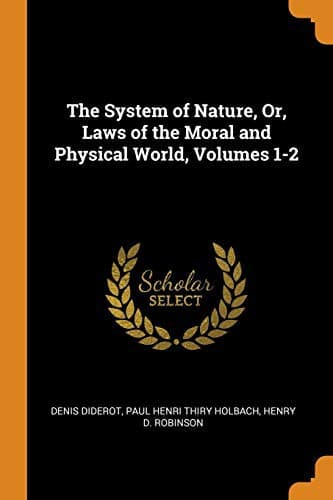
The System of Nature, or, the Laws of the Moral and Physical World. Volume 2Holbach, Paul Henri Thiry, baron d'
Religion
The System of Nature, or, the Laws of the Moral and Physical World. Volume 2
Holbach, Paul Henri Thiry, baron d'
Materialism; Philosophy and religion; Psychology
If man was subjected to an absolute monarch, to a sultan who should keep
himself secluded from his subjects; who followed no rule but his own
desires; who did not feel himself bound by any duty; who could for ever
punish the offences committed against him; whose fury it was easy
to provoke; who was irritated even by the ideas, the thoughts of his
subjects; whose displeasure might be incurred without even their own
knowledge; the name of such a sovereign would assuredly be sufficient to
carry trouble, to spread terror, to diffuse consternation into the very
souls of those who should hear it pronounced; his idea would haunt them
every where--would unceasingly afflict them--would plunge them into
despair. What tortures would not their mind endure to discover this
formidable being, to ascertain the secret of pleasing him! What labour
would not their imagination bestow, to discover what mode of conduct
might be able to disarm his anger! What fears would assail them, lest
they might not have justly hit upon the means of assuaging his wrath!
What disputes would they not enter into upon the nature, the qualities
of a ruler, equally unknown to them all! What a variety of means would
not be adopted, to find favour in his eyes; to avert his chastisement!
Such is the history of the effects superstition has produced upon the
earth. Man has always been panic-struck, because the systems adopted
never enable him to form any correct opinion, any fixed ideas, upon
a subject so material to his happiness; because every thing conspired
either to give his ideas a fallacious turn, or else to keep his mind in
the most profound ignorance; when he was willing to set himself
right, when he was sedulous to examine the path which conducted to his
felicity, when he was desirous of probing opinions so consequential to
his peace, involving so much mystery, yet combining both his hopes
and his fears, he was forbidden to employ the only proper method,--HIS
REASON, guided by his experience; he was assured this would be an
offence the most indelible. If he asked, Wherefore his reason had then
been given him, since he was not to use it in matters of such high
behest? he was answered, those were mysteries of which none but the
initiated could be informed; that it sufficed for him to know, that
the reason which he seemed so highly to prize, which he held in so
much esteem, was his most dangerous enemy--his most inveterate, most
determined foe. Where can be the propriety of such an argument? Can it
really be that reason is dangerous? If so, the Turks are justified in
their predilection for madmen: but to proceed, he is told that he must
believe in the gods, not question the mission of their priests; in
short, that he had nothing to do with the laws they imposed, but to
obey them: when he then required that these laws might at least be
made comprehensible to him; that he might be placed in a capacity
to understand them; the old answer was returned, that they were
Public-domain text, read in full here on John Shaqi.
Reviews
Reviews
No reviews yet
Be the first to share your thoughts on this work.
Elsewhere in the archive
Join the Discussion
Join the discussion
Sign in to leave a comment or review.
Sign InorCreate an account