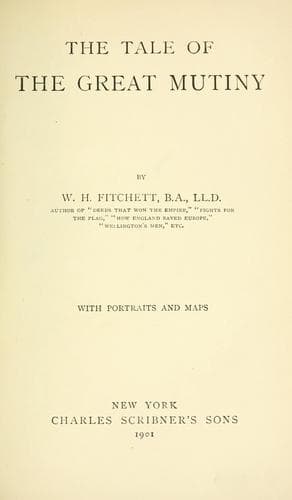
The Tale of the Great MutinyFitchett, W. H. (William Henry)
History
The Tale of the Great Mutiny
Fitchett, W. H. (William Henry)
India -- History -- Sepoy Rebellion, 1857-1858
The Sepoy conscience was, in truth, of very eccentric sensitiveness.
Native hands made up the accused cartridges without concern; the Sepoys
themselves used them freely—when they could get them—against the British
after the Mutiny broke out. But a fanatical belief on the part of the
Sepoys, that these particular cartridges concealed in their greasy folds
a dark design against their religion, was undoubtedly the immediate
occasion of the Great Mutiny. Yet it would be absurd to regard this as
its single producing cause. In order to assert this, we must forget all
the other evil forces at work to produce the cataclysm: the annexation of
Oude; the denial of the sacred right of “adoption” to the native princes;
the decay of discipline in the Sepoy ranks; the loss of reverence for
their officers by the men, &c.
The Sepoys, it is clear, were, on many grounds, discontented with the
conditions of their service. The keen, brooding, and somewhat melancholy
genius of Henry Lawrence foresaw the coming trouble, and fastened on this
as one of its causes. In an article written in March 1856, he says that
the conditions of the Indian Army denied a career to any native soldier
of genius, and this must put the best brains of the Sepoys in quarrel
with the British rule. Ninety out of every hundred Sepoys, he said in
substance, are satisfied; but the remaining ten are discontented, some
of them to a dangerous degree; and the discontented ten were the best
soldiers of the hundred! But, as it happened, the Mutiny threw up no
native soldier of genius, except, perhaps, Tantia Topee, who was _not_ a
Sepoy!
“The salt water” was undoubtedly amongst the minor causes which provoked
the Mutiny. The Sepoys dreaded the sea; they believed they could not
cross it without a fatal loss of caste, and the new form of military
oath, which made the Sepoy liable for over-sea service, was believed, by
the veterans, to extend to them, even though they had not taken it: and
so the Sepoy imagination was disquieted.
Lord Dalhousie’s over-Anglicised policy, it may be added, was at once too
liberal, and too impatient, for the Eastern mind, with its obstinacy of
habit, its hatred of change, its easily-roused suspiciousness. As Kaye
puts it, Lord Dalhousie poured his new wine into old bottles, with too
rash a hand. “The wine was good wine, strong wine, wine to gladden the
heart of man;” but poured into such ancient and shrunken bottles too
rashly, it was fatal. It was because we were “too English,” adds Kaye,
that the great crisis arose; and “it was only because we were English
that, when it arose, it did not overwhelm us.” We trod, in a word, with
heavy-footed British clumsiness on the historic superstitions, the
ancient habitudes of the Sepoys, and so provoked them to revolt. But the
dour British character, which is at the root of British clumsiness, in
the end, overbore the revolt.
Public-domain text, read in full here on John Shaqi.
Reviews
Reviews
No reviews yet
Be the first to share your thoughts on this work.
Join the Discussion
Join the discussion
Sign in to leave a comment or review.
Sign InorCreate an account