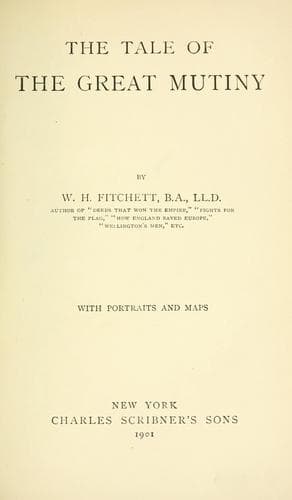
The Tale of the Great MutinyFitchett, W. H. (William Henry)
History
The Tale of the Great Mutiny
Fitchett, W. H. (William Henry)
India -- History -- Sepoy Rebellion, 1857-1858
The very virtues of the British rule, thus proved its peril. Its cool
justice, its steadfast enforcement of order, its tireless warfare against
crime, made it hated of all the lawless and predatory classes. Every
native who lived by vice, chafed under a justice which might be slow and
passionless, but which could not be bribed, and in the long-run could not
be escaped.
Some, at least, of the dispossessed princes, diligently fanned these
wild dreams and wilder suspicions which haunted the Sepoy mind, till
it kindled into a flame. The Sepoys were told they had conquered India
for the English; why should they not now conquer it for themselves? The
chupatties—mysterious signals, coming whence no man knew, and meaning, no
man could tell exactly what—passed from village to village. Usually with
the chupatti ran a message—“Sub lal hojaega” (“everything will become
red”)—a Sibylline announcement, which might be accepted as a warning
against the too rapid spread of the English raj, or a grim prediction
of universal bloodshed. Whence the chupatties came, or what they exactly
meant, is even yet a matter of speculation. The one thing certain is,
they were a storm signal, not very intelligible, perhaps, but highly
effective.
That there was a conspiracy throughout Bengal for the simultaneous revolt
of all Sepoys on May 31, cannot be doubted, and, on the whole, it was
well for the English raj that the impatient troopers broke out at Meerut
before the date agreed upon.
Sir Richard Temple, whose task it was to examine the ex-king of Delhi’s
papers after the capture of the city, found amongst them an immense
number of letters and reports from leading Mohammedans—priests and
others. These letters glowed with fanatical fire. Temple declared they
convinced him that “Mohammedan fanaticism is a volcanic agency, which
will probably burst forth in eruptions from time to time.” But were
Christian missions any source of political peril to British rule in
India? On this point John Lawrence’s opinion ought to be final. He
drafted a special despatch on the subject, and Sir Richard Temple, who
was then his secretary, declares he “conned over and over again every
paragraph as it was drafted.” It represented his final judgment on the
subject. He held that “Christian things done in a Christian way could
never be politically dangerous in India.” While scrupulously abstaining
from interference in the religions of the people, the Government, he
held, “should be more explicit than before”—not less explicit—“in avowing
its Christian character.”
Public-domain text, read in full here on John Shaqi.
Reviews
Reviews
No reviews yet
Be the first to share your thoughts on this work.
Join the Discussion
Join the discussion
Sign in to leave a comment or review.
Sign InorCreate an account