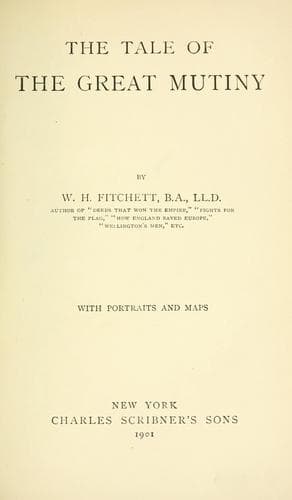
The Tale of the Great MutinyFitchett, W. H. (William Henry)
History
The Tale of the Great Mutiny
Fitchett, W. H. (William Henry)
India -- History -- Sepoy Rebellion, 1857-1858
On the evening of May 10, 1857, the church bells were sounding their
call to prayer across the parade-ground, and over the roofs of the
cantonment at Meerut. It had been a day of fierce heat; the air had
scorched like a white flame; all day long fiery winds had blown, hot as
from the throat of a seven times heated furnace. The tiny English colony
at Meerut—languid women, white-faced children, and officers in loosest
undress—panted that long Sunday in their houses, behind the close blinds,
and under the lazily swinging punkahs. But the cool night had come, the
church bells were ringing, and in the dusk of evening, officers and their
wives were strolling or driving towards the church. They little dreamed
that the call of the church bells, as it rose and sank over the roofs
of the native barracks, was, for many of them, the signal of doom. It
summoned the native troops of Meerut to revolt; it marked the beginning
of the Great Mutiny.
Yet the very last place, at which an explosion might have been expected,
was Meerut. It was the one post in the north-west where the British
forces were strongest. The Rifles were there, 1000 strong; the 6th
Dragoons (Carabineers), 600 strong; together with a fine troop of horse
artillery, and details of various other regiments. Not less, in a word,
than 2200 British troops, in fair, if not in first-class, fighting
condition, were at the station, while the native regiments at Meerut,
horse and foot, did not reach 3000. It did not need a Lawrence or a
Havelock at Meerut to make revolt impossible, or to stamp it instantly
and fiercely out if it were attempted. A stroke of very ordinary
soldiership might have accomplished this; and in that event, the Great
Mutiny itself might have been averted.
The general in command at Meerut, however, had neither energy nor
resolution. He had drowsed and nodded through some fifty years of routine
service, rising by mere seniority. He was now old, obese, indolent, and
notoriously incapable. He had agreeable manners, and a soothing habit of
ignoring disagreeable facts. Lord Melbourne’s favourite question, “Why
can’t you leave it alone?” represented General Hewitt’s intellect. These
are qualities dear to the official mind, and explain General Hewitt’s
rise to high rank, but they are not quite the gifts needed to suppress a
mutiny. In General Hewitt’s case, the familiar fable of an army of lions
commanded by an ass, was translated into history once more.
Public-domain text, read in full here on John Shaqi.
Reviews
Reviews
No reviews yet
Be the first to share your thoughts on this work.
Join the Discussion
Join the discussion
Sign in to leave a comment or review.
Sign InorCreate an account