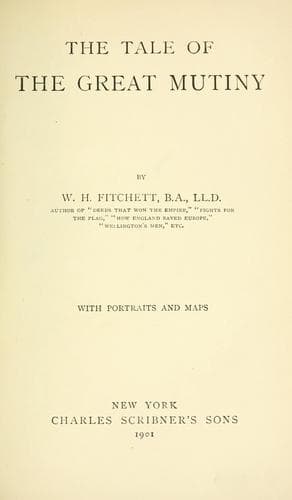
The Tale of the Great MutinyFitchett, W. H. (William Henry)
History
The Tale of the Great Mutiny
Fitchett, W. H. (William Henry)
India -- History -- Sepoy Rebellion, 1857-1858
All the passion, the tragedy, and the glory of the Indian Mutiny
gathers round three great sieges. We vaguely remember a hundred tales
of individual adventure elsewhere on the great stage of the Mutiny; we
have perhaps a still fainter and more ghostly mental image of the combats
Havelock fought on the road to Lucknow, and the battles by which Campbell
crushed this body of rebels or that. But it is all a mist of confused
recollections, a kaleidoscope of fast-fading pictures. But who does not
remember the three great sieges of the Mutiny—Cawnpore, Lucknow, Delhi?
The very names are like beacon lights flaming through leagues of night!
At Cawnpore the British were besieged and destroyed, a tragedy due to
Wheeler’s fatal blunder in choosing the site where the British were to
make their stand for life, and his failure in collecting provisions for
the siege. At Lucknow, again, the British were besieged, but triumphed,
becoming themselves in turn the besiegers. Success here was due to the
genius of Henry Lawrence in organising the defences of the Residency,
and his energy in storing supplies before the Mutiny broke out. The
brave men who died behind Wheeler’s ridges of earth, or in the Slaughter
Ghaut at Cawnpore, showed valour as lofty and enduring as that of the men
who held the Residency with such invincible courage at Lucknow. But the
interval between the tragedy at Cawnpore and the triumph at Lucknow is
measured by the difference between the two leaders, Wheeler and Lawrence.
Both were brave men, but Lawrence was a great captain.
At Delhi the British, from the outset, were the besiegers, and nothing
in British history—not the story of Sir Richard Grenville and the
_Revenge_, of the Fusileers at Albuera, or of the Guards at Inkerman—is
a more kindling tale of endurance and valour than the story of how for
months a handful of British clung to the Ridge outside Delhi, fighting
daily with foes ten times more numerous than themselves, and yet
besieging—or maintaining the show of besieging—the great city which was
the nerve-centre and heart of the whole Mutiny.
[Illustration: LORD LAWRENCE
_Reproduced from the Life of Lord Lawrence by permission R. BOSWORTH
SMITH, Esq._]
At Cawnpore and Lucknow the British fought for existence. At Delhi they
fought for empire! While the British flag flew from the Ridge at Delhi
it was a symbol that the British _raj_ was still undestroyed. It was a
red gleaming menace of punishment to all rebels. Had that flag fallen
for twenty-four hours, India, for a time at least, would have been lost
to England. But it flew proudly and threateningly aloft, undestroyed by
a hundred attacks, till at last Nicholson led his stormers through the
Cashmere Gate, and the fate of the Mutiny was sealed!
Public-domain text, read in full here on John Shaqi.
Reviews
Reviews
No reviews yet
Be the first to share your thoughts on this work.
Elsewhere in the archive
Join the Discussion
Join the discussion
Sign in to leave a comment or review.
Sign InorCreate an account