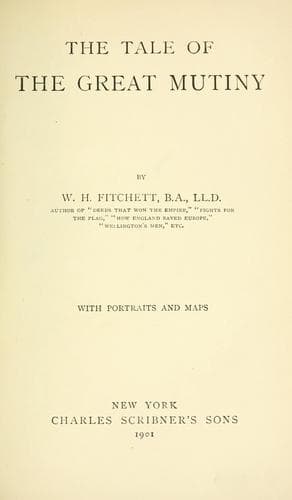
The Tale of the Great MutinyFitchett, W. H. (William Henry)
History
The Tale of the Great Mutiny
Fitchett, W. H. (William Henry)
India -- History -- Sepoy Rebellion, 1857-1858
According to Sir Herbert Edwardes, it was the act of an English boy that
saved the Punjaub. A very youthful operator—a mere lad—named Brendish,
was by some accident alone in the Delhi Telegraph Office. When the
Mutiny broke out he had to flee like the rest; but, before leaving, he
wired a somewhat incoherent message to Umballa. “We must leave office,”
it ran; “all the bungalows are on fire, burning down by the Sepoys of
Meerut. They came in this morning.... Nine Europeans are killed.” That
message reached Umballa, was sent on to Lahore, and was read there as
a danger-signal so expressive, that the authorities at once decided
to disarm the native troops at that station. The cryptic message was
then flashed on to Peshawur, and was there read in the same sense, and
acted upon with the same promptitude. Brendish was one of the few who
afterwards escaped from Delhi.
At some of the stations, where cool heads and steadfast courage
prevailed, the Sepoys were disarmed with swiftness and decision. This
was especially the case in the Punjaub, where the cause of England was
upheld by the kingly brain of John Lawrence, the swift decision of
Herbert Edwardes, and the iron courage of Neville Chamberlain and of John
Nicholson.
Lord Roberts has told how, on May 12, he was present as scribe at a
council of war held in Peshawur. Round the table sat a cluster of gallant
soldiers, such as might well take charge of the fortunes of a nation in
the hour of its deadliest peril. Herbert Edwardes was there, and Neville
Chamberlain, and Nicholson. They had to consider how to hold the Punjaub
quiet while all Bengal was in a flame of mutiny. The Punjaub was a newly
conquered province; its warlike population might well be expected to
seize the first opportunity of rising against its conquerors. It was
held by an army of over 80,000 troops, and of these only 15,000 were
British—the rest, some 65,000, were almost sure to join the Mutiny. For
every British soldier in the Punjaub, that is, there were four probable
mutineers, while behind these was a warlike population, just subdued by
the sword, and ready to rise again.
But the cool heads that met in that council were equal to their task.
It was resolved to disarm all doubtful regiments, and raise new forces
in their stead in the Punjaub itself, and from its wild frontier clans.
A movable column, light-footed, hard-hitting, was to be formed under
Neville Chamberlain’s command, with which to smite at revolt whenever it
lifted its head. So the famous Movable Column came into being, commanded
in turn by Chamberlain and by Nicholson. That column itself had to be
purged heroically again and again to cleanse it from mutinous elements,
till it practically came to consist of one field-battery, one troop of
horse-artillery, and one infantry regiment, all British. Then it played a
great part in the wild scenes of the Mutiny.
Public-domain text, read in full here on John Shaqi.
Reviews
Reviews
No reviews yet
Be the first to share your thoughts on this work.
Join the Discussion
Join the discussion
Sign in to leave a comment or review.
Sign InorCreate an account