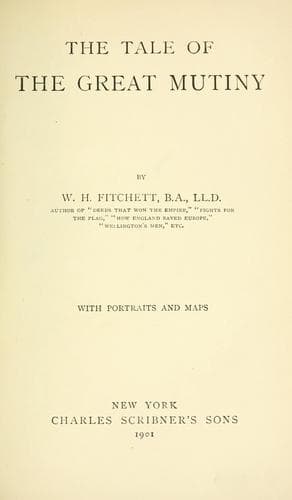
The Tale of the Great MutinyFitchett, W. H. (William Henry)
History
The Tale of the Great Mutiny
Fitchett, W. H. (William Henry)
India -- History -- Sepoy Rebellion, 1857-1858
Colonel Simpson of the 6th, who was in command, cherished the most
enthusiastic faith in his men. He looked on his cherished Sepoys as
a regiment of mere dusky-skinned Sir Galahads; each one of them was
as faithful as Milton’s Abdiel! Some sixty superannuated British
artillerymen, the youngest of them over fifty years of age, had been
thrown hurriedly into the fort itself as a garrison; and Colonel Simpson
strongly urged that his regiment should be taken into the fort in their
place as “a proof of confidence.” This would have been like putting a
committee of wolves inside the fold!
At evening parade on June 6, Colonel Simpson read to his Sepoys the
formal thanks of the Governor-General for their virtuous offer to go out
and fight the wicked mutineers at Delhi. He added a glowing eulogium of
their loyalty on his own account. The Sepoys cheered, Colonel Simpson and
his fellow-officers adjourned to the mess-room, and no doubt discoursed
with great comfort on the much-enduring fidelity of their men. Within
four hours of being thanked by Lord Canning and praised by Colonel
Simpson, the “faithful” Sepoys of the 6th Infantry had murdered seventeen
officers and all the women and children of English blood they could
capture, and were in full march to Delhi.
The tale is typical. At nine o’clock a bugle call sounded from the
lines—it was the signal for revolt. The men rushed to arms. The Sepoy
artillerymen holding the bridge swung their guns round, and opened fire
on their officers. Harward and Alexander, in command of the Native
Irregular Horse, and both officers of great promise, leaped into their
saddles, and galloped fiercely to the bridge to recapture the guns. When
they gave the order to charge, their treacherous followers suddenly
pulled up; and, followed by only three troopers, the officers rode at
the guns. Alexander, rising in his stirrups for one gallant sword-stroke,
was shot through the heart; and Harward had to gallop for his life.
Simpson and his officers in the meanwhile ran to the parade-ground to
“expostulate” with their men. Five officers were instantly shot down.
Colonel Simpson was beginning to address a new series of compliments
to his faithful Sepoys, but they turned their muskets upon him, and
interrupted his eloquence with a volley. By some miracle he escaped and
galloped off to the fort. He had to ride past the mess-house, and the
mess guard turned out and took pot shots at him as he rode. The unhappy
colonel reached the gate of the fort with a dying horse, a wounded arm,
and an entirely new theory of Sepoy loyalty.
Public-domain text, read in full here on John Shaqi.
Reviews
Reviews
No reviews yet
Be the first to share your thoughts on this work.
Join the Discussion
Join the discussion
Sign in to leave a comment or review.
Sign InorCreate an account