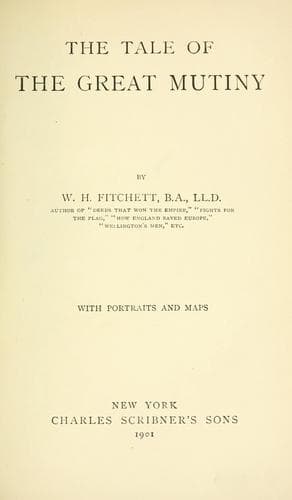
The Tale of the Great MutinyFitchett, W. H. (William Henry)
History
The Tale of the Great Mutiny
Fitchett, W. H. (William Henry)
India -- History -- Sepoy Rebellion, 1857-1858
It was a true instinct which, after this, taught the British soldier
to call every mutinous Sepoy a “Pandy.” That incident at Barrackpore
is really the history of the Indian Mutiny in little. All its elements
are there: the bhang-stimulated fanaticism of the Sepoy, with its quick
contagion, running through all Sepoy ranks; the hasty rush of the
solitary officer, gallant, but ill-fated, a single man trying to suppress
a regiment. Here, too, is the colonel of the 34th, who, with a cluster of
regiments on the point of mutiny, decides that it is “useless” to face
a dangerously excited Sepoy armed with a musket, and retires to “report”
the business to his brigadier. He is the type of that failure of official
nerve—fortunately very rare—which gave the Mutiny its early successes.
General Hearsey, again, with his grim “D⸺ his musket!” supplies the
example of that courage, swift, fierce, and iron-nerved, that in the end
crushed the Mutiny and restored the British Empire in India.
The Great Mutiny, as yet, has found neither its final historian, nor
its sufficient poet. What other nation can show in its record such a
cycle of heroism as that which lies in the history of the British in
India between May 10, 1857—the date of the Meerut outbreak, and the
true beginning of the Mutiny—and November 1, 1858, when the Queen’s
proclamation officially marked its close? But the heroes in that great
episode—the men of Lucknow, and Delhi, and Arrah, the men who marched
and fought under Havelock, who held the Ridge at Delhi under Wilson,
who stormed the Alumbagh under Clyde—though they could make history,
could not write it. There are a hundred “Memoirs,” and “Journals,” and
“Histories” of the great revolt, but the Mutiny still waits for its
Thucydides and its Napier. Trevelyan’s “Cawnpore,” it is true, will hold
its readers breathless with its fire, and movement, and graphic force;
but it deals with only one picturesque and dreadful episode of the Great
Mutiny. The “History of the Mutiny,” by Kaye and Malleson, is laborious,
honest, accurate; but no one can pretend that it is very readable. It
has Kinglake’s diffuseness without Kinglake’s literary charm. The work,
too, is a sort of literary duet of a very controversial sort. Colonel
Malleson, from the notes, continually contradicts Sir John Kaye in the
text, and he does it with a bluntness, and a diligence, which have quite
a humorous effect.
Public-domain text, read in full here on John Shaqi.
Reviews
Reviews
No reviews yet
Be the first to share your thoughts on this work.
Join the Discussion
Join the discussion
Sign in to leave a comment or review.
Sign InorCreate an account