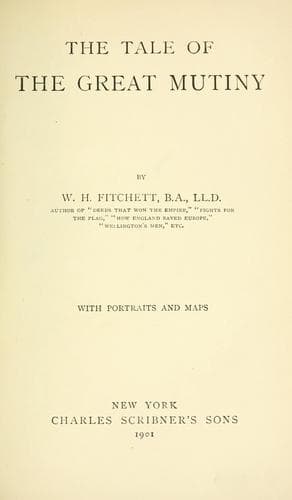
The Tale of the Great MutinyFitchett, W. H. (William Henry)
History
The Tale of the Great Mutiny
Fitchett, W. H. (William Henry)
India -- History -- Sepoy Rebellion, 1857-1858
Not only is the Mutiny without an historian, but it remains without any
finally convincing analysis of its causes. Justin McCarthy’s summary of
the causes of the Mutiny, as given in his “History of Our Own Times,” is
a typical example of wrong-headed judgment. Mr. McCarthy contemplates the
Mutiny through the lens of his own politics, and almost regards it with
complacency as a mere struggle for Home Rule! It was not a Mutiny, he
says, like that at the Nore; it was a revolution, like that in France at
the end of the eighteenth century. It was “a national and religious war,”
a rising of the many races of India against the too oppressive Saxon. The
native princes were in it as well as the native soldiers.
The plain facts of the case are fatal to that theory. The struggle was
confined to one Presidency out of three. Only two dynastic princes—Nana
Sahib and the Ranee of Jhansi—joined in the outbreak. The people in the
country districts were passive; the British revenue, except over the
actual field of strife, was regularly paid. If their own trained native
soldiery turned against the British, other natives thronged in thousands
to their flag. A hundred examples might be given where native loyalty and
valour saved the situation for the English.
There were Sepoys on both sides of the entrenchment at Lucknow. Counting
camp followers, native servants, &c., there were two black faces to every
white face under the British flag which fluttered so proudly over the
historic Ridge at Delhi. The “protected” Sikh chiefs, by their fidelity,
kept British authority from temporary collapse betwixt the Jumna and
the Sutlej. They formed what Sir Richard Temple calls “a political
breakwater,” on which the fury of rebellious Hindustan broke in vain. The
Chief of Pattalia employed 5000 troops in guarding the trunk road betwixt
the Punjaub and Delhi, along which reinforcements and warlike supplies
were flowing to the British force on the Ridge. This enabled the whole
strength of the British to be concentrated on the siege. The Chief of
Jhind was the first native ruler who appeared in the field with an armed
force on the British side, and his troops took part in the final assault
on Delhi. Golab Singh sent from his principality, stretching along the
foot of the Himalayas, strong reinforcements to the British troops
besieging Delhi. “The sight of these troops moving against the mutineers
in the darkest hour of British fortunes produced,” says Sir Richard
Temple, “a profound moral effect on the Punjaub.”
Public-domain text, read in full here on John Shaqi.
Reviews
Reviews
No reviews yet
Be the first to share your thoughts on this work.
Join the Discussion
Join the discussion
Sign in to leave a comment or review.
Sign InorCreate an account