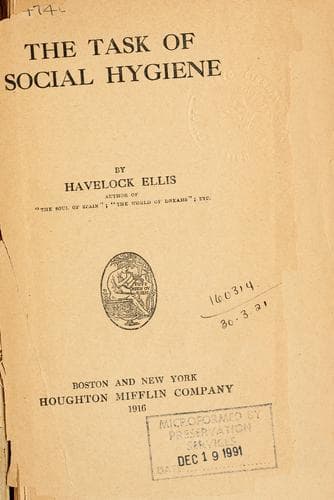
Eugenics; Sexual ethics; Women -- Social and moral questions
Robert Owen, who, like Saint-Simon in France, gave so extraordinary an
impulse to all efforts at social reorganization, and who planted the
seed of many modern movements, could not fail to extend his influence to
the region of sex. A disciple of his, William Thompson, who still holds
a distinguished position in the history of the economic doctrines of
Socialism, wrote, under the inspiration of a woman (a Mrs. Wheeler),
and published in 1825, an _Appeal of One Half of the Human Race, Women,
against the Pretensions of the Other Half, Men, to retain them in
Political, and thence in Civil and Domestic Slavery_. It is a thorough
and logical, almost eloquent, demand for the absolute social equality of
the sexes.[46]
Forty years later, Mill, also inspired by a woman, published his
_Subjection of Women_. However partial and inadequate it may seem to us,
this was at that day a notable book. Mill's clear vision and feminine
sensibilities gave freshness to his observations regarding the condition
and capacity of women, while his reputation imparted gravity and
resonance to his utterances. Since then the signs in literature of the
breaking up of the status of women have become far too numerous to be
chronicled even in a volume. It is enough to have mentioned here some
typical initiatory names. Now, the movement may be seen at work
anywhere, from Norway to Italy, from Russia to California. The status
which women are now entering places them, not, as in the old communism,
in large measure practically above men, nor, as in the subsequent
period, both practically and theoretically in subordination to men. It
places them side by side, with like rights and like duties in relation
to society.
II
Public-domain text, read in full here on John Shaqi.
Reviews
Reviews
No reviews yet
Be the first to share your thoughts on this work.
Join the Discussion
Join the discussion
Sign in to leave a comment or review.
Sign InorCreate an account